Noor Tamari—Throughout your practice, you weave together histories of Lakota and Native abstraction and Modernist abstraction. To begin this conversation, what led you to this specific field of artistic practice?
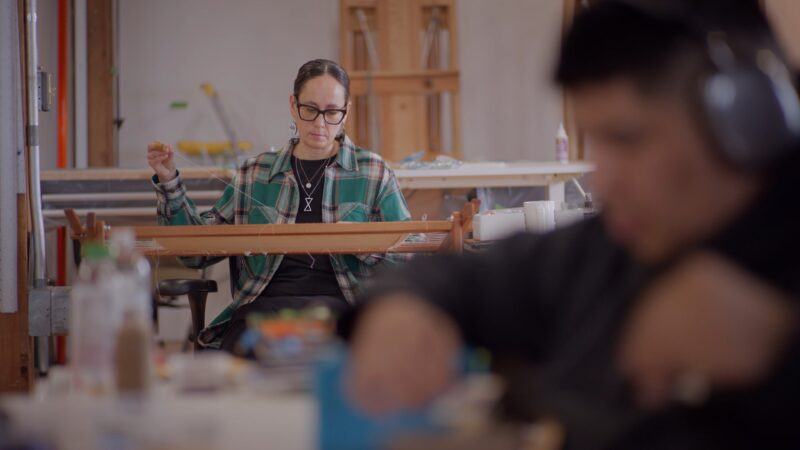
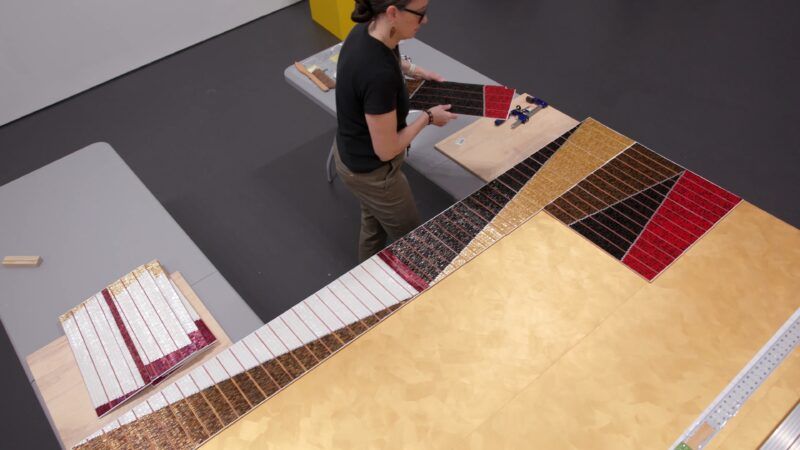
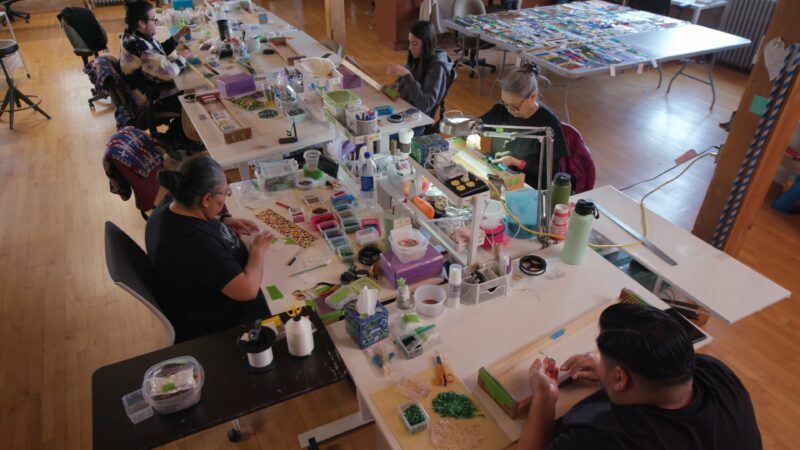
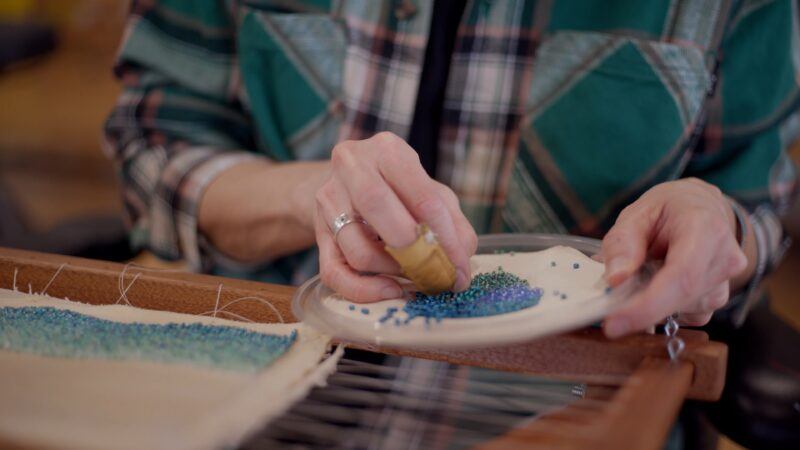
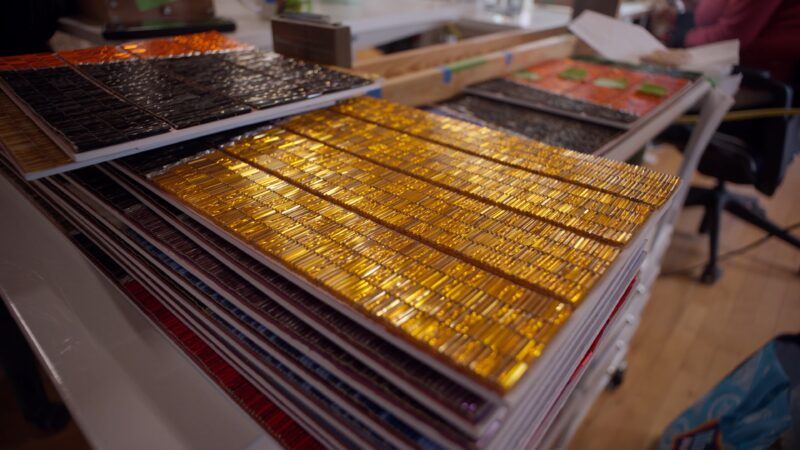
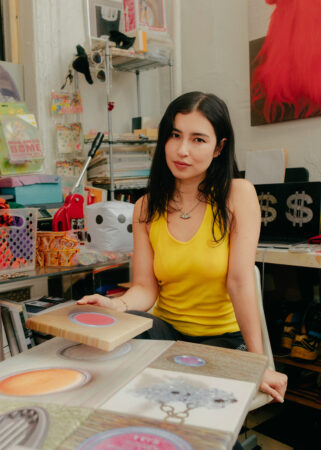
Dyani White Hawk—This is a multilayered answer simply because my studio practice exists in so many different ways with so many different approaches. My studio practice is grounded in the practices of beadwork and painting, and in the practice of porcupine quillwork and other Lakota artistic forms. But it’s also branched out over the years to include video installation, performance pieces, public artwork, and work in glass and mosaic.
My practice today is an evolution of forms that have consistently been my favorite kind of making. I absolutely love to paint, do beadwork, quillwork, and to sew. I was learning how to make aspects of Lakota dance regalia before I had formal art school teaching, so my studio practice examines, picks apart, and patches back together aspects of mainstream American art history and Lakota art history. Those are all pieces of my life journey, my upbringing, and my education.
NT—In many of your works, such as Nourish (2024), Wopila|Lineage (2022), and Visiting (2024), we are confronted by the monumental scale of your work. Can you discuss the importance of scale and its relationship to space in your work?
DWH—Part of it comes from the desire to play hard and dream big, and from how joyful it is to look at or think about a giant canvas. I have always had a desire to paint big and to make big works; to really have the freedom to explore and just dream bigger, but there’s a specific strategy in that as well.
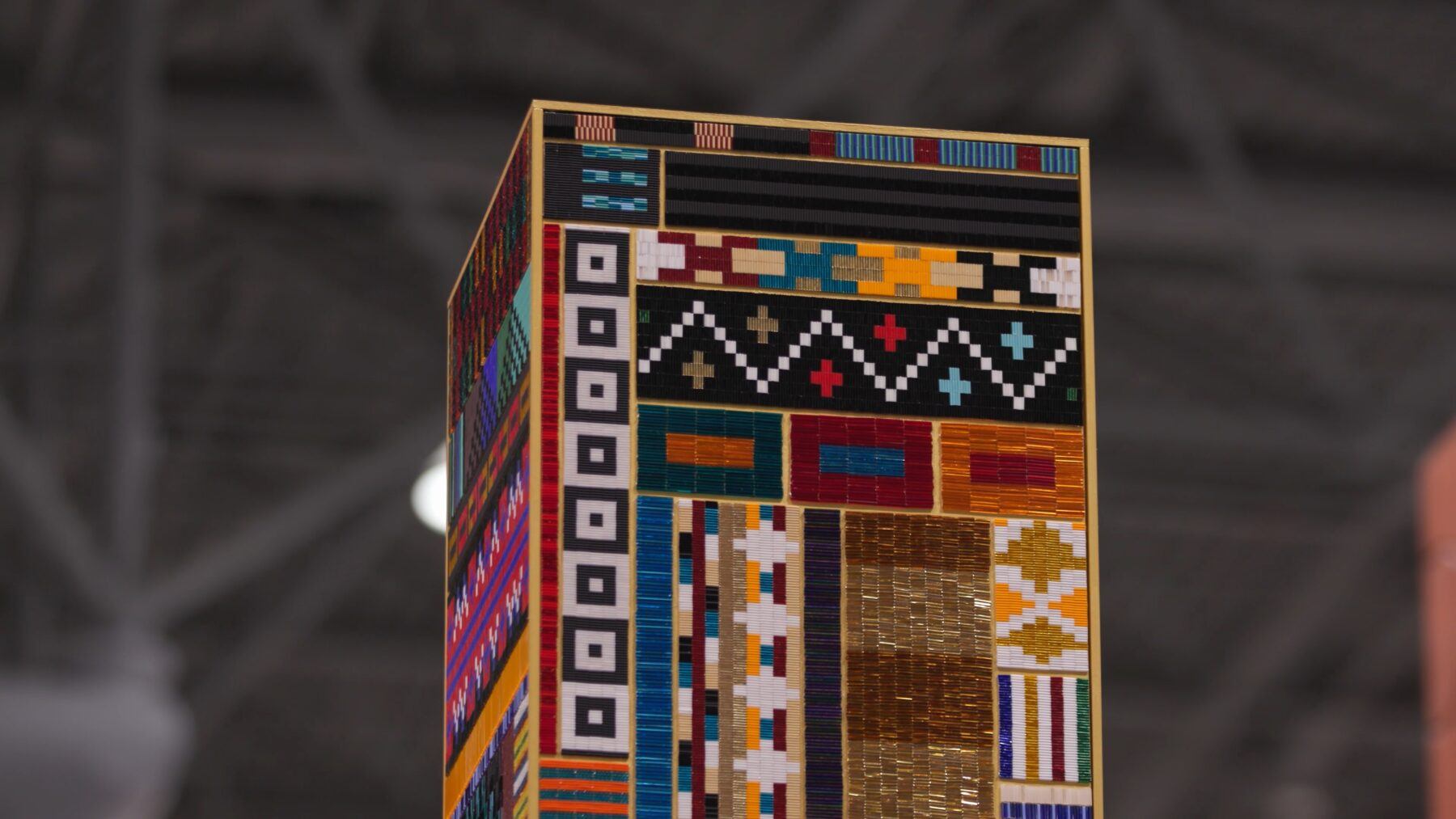
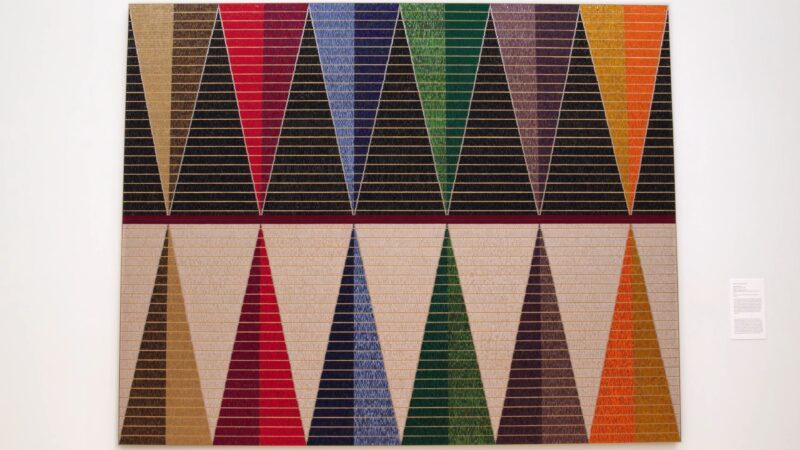
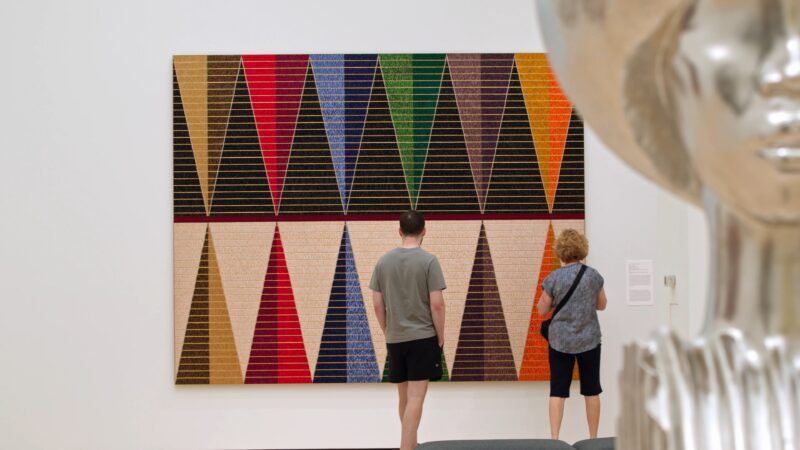
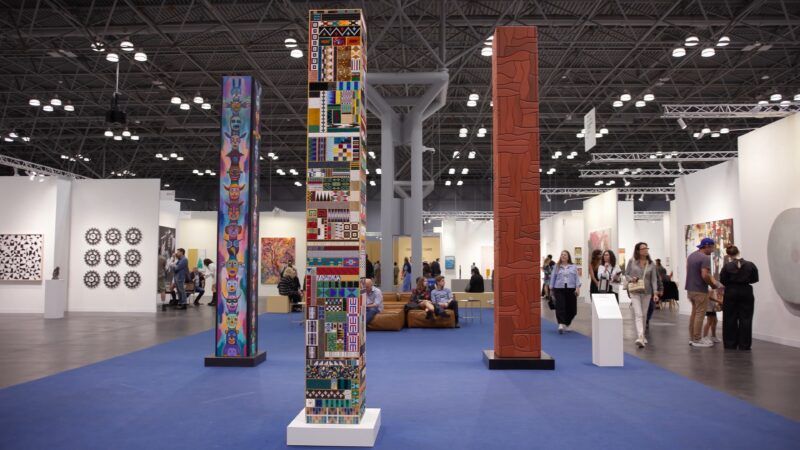
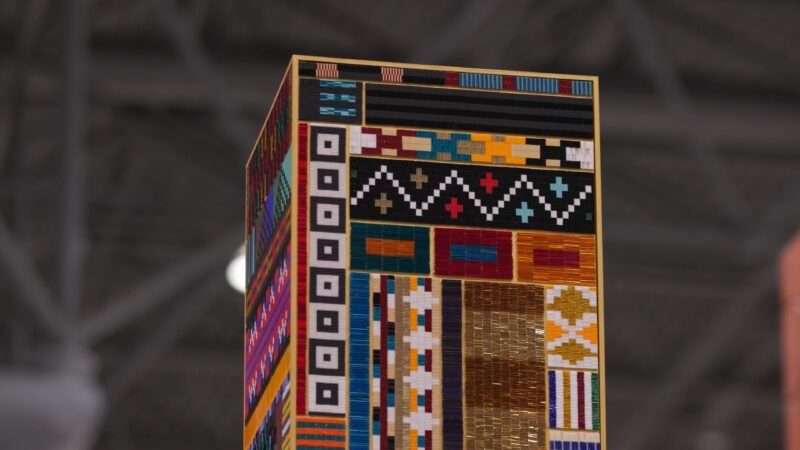
The Wopila | Lineage series, which was first in the 2022 Whitney Biennial, was an 8-foot-high by 14-foot-wide fully beaded painting. At the time, the 48 by 48-inch beaded works were the largest I could physically accomplish. It was really about rising to the challenge and figuring out how to scale up. Beadwork takes so long, is such a labor-intensive process, and beads are such a tiny medium. Making the 48 by 48-inch beaded paintings was its own challenging feat. The question then became how to transition those processes into a huge, museum-sized scale?
These are intentionally large paintings that center the history of porcupine quillwork and lane stitch beadwork, specifically the undervalued lineage of abstraction that Lakota women and other Native American women have upheld for generations. These lineages are a part of the artistic history of this continent and the history of abstraction, yet they have not been centered in the discourse of abstraction. Taking those histories and creating large-scale paintings that are unavoidable, that can partner on a wall next to works by the European and Euro-American male painters that have been credited with the history of abstraction, is a strategy to remind folks that abstraction has been happening on this continent before colonization and at the same time as the canonical male abstract painters. These works make this conversation unavoidable. It’s a way to say, “You will see this and we will talk about it.”
NT—I really love that. In the same vein, your works emphasize a certain aesthetic importance. What role does beauty play in your work? How is centering that a conscious, and often political, artistic decision?
DWH—Making something large but also beautiful serves a dual purpose. I really believe that beauty is medicinal: it fills our soul and feeds our spirit in a way that is a common human experience across culture, space, age, and time. We seek beauty out in nature, in one another, and in our creations; we exalt it, we crave it, we look for it, we pay for it, we create it, it feeds us in so many ways. So, I crave it in my work, I want the audience to be able to stand in front of my work and have that moment of awe we all desire. When you stand in the midst of a forest, or you stand at the edge of the ocean, or you stand at a creek, or a fresh snowfall, we get these important moments of awe that’s a common human experience. I want my work to offer the audience a moment of awe, a moment of spiritual nourishment.
After that kind of physical reaction, I want the audience to be able to dig into the conceptual storyline or underpinnings that drive the work. I want to offer this moment of beauty as a gift and offering of reciprocity: the work is asking people to stay longer and think about what the piece is addressing, because sometimes it is challenging subject matter. I’m talking about colonization, unjust value systems, and harm to communities. I’m talking about the challenging nature of American history, American art history, and discrimination in both. There’s a lot of tough discussion embedded within these beautiful pieces.
I’ve learned that, when you offer something on the front end and you start with a place of recognized shared humanity, we are more open with one another. We’re more willing to participate in hard conversations if we feel nurtured, seen, and honored. So beauty, for me, is something that I desire for myself. It’s something that I recognize that other people desire and that other people deserve, and I want to gift that to them. It’s both a gift and a strategy that I hope will encourage people to stay longer, think critically, and remain engaged in the deeper dialogue art can offer us all.
NT—This fall, you’ll be featured in the first episode of Season 12 of Art in the Twenty-First Century, titled “Between Worlds.” In discussions around this episode and this title, you’ve talked about how this title follows in the footsteps of damaging tropes and narratives that other Native and Indigenous artists have navigated over time – could you talk more about that?
DWH—I wish “Between Worlds” wasn’t the title because I don’t want to be pigeonholed into a separate world within the field. One of the biggest areas of growth that needs to take place within the contemporary art field is that we have to get to a place where all artists’ voices are included in our broad contemporary art spaces.
The reality is, we don’t live in two worlds, we live in one shared world. As humans, we have not figured out how to peacefully, honorably, and respectfully coexist and honor one another’s cultures, backgrounds, and communities in a way that recognizes sharing of this space. Consequently, we split ourselves up and we end up with this idea of two worlds. I believe that we will continue to suffer and treat each other horribly until we figure out the truth that we are all related. We can’t pretend that what’s happening in one community, whether it’s abuse, violence, starvation, war, or any of the ills of human society doesn’t affect us all. It’s not true, it always eventually affects us all.
We have to figure out how to evolve and grow as humans, so that we can understand that we do live in a singular world and that our communities (while unique and in some ways separate) are one hundred percent interconnected. It is imperative that we learn to see that, and make our choices according to that interconnectivity.
NT—Watching your segment, you discuss the Kapemni form that appears in many of your paintings. In describing it, you say, “at its core, those symbols speak to ideas of balance, of our relationship between earth and sky, our relationship between here and the spiritual realm,” which perhaps offers a different way of thinking about “Between Worlds” as something that we all share. I’m curious if you could talk more about your use of the Kapemni form in your work, and this idea that we all exist in a state of betweenness, oneness, and interconnectedness.
DWH—The Kapemni form boils down to just a few core themes and speaks to the connections between the earth and sky, or the earth and the spiritual realm. It speaks to ideas of balance and the interconnection of those spaces.
For me, it serves as this constant reminder of connectivity: human to human connectivity, human to spiritual connectivity, human to global connectivity, human to cosmos connectivity. I need those reminders. When we’re faced with loss on a personal level, on a communal level, on a global level, when we’re faced with decisions on how we’re going to treat another human being, how we’re going to treat another community, how we’re going to treat the land that we share, how we’re going to think about our future generations, that reminder of connectivity is a guidepost. It is so easy to get wrapped up in our day-to-day lives that we forget how connected we are. We forget how important our decisions are and how much our decisions impact one another in ways we can’t even comprehend.
I return to the teachings of the symbol over and over again: first as a personal reminder but also because it is imperative that, as humans, we have reminders of things outside of ourselves. That is something within Indigenous worldviews that can be beneficial to the greater public. That is not a value system that’s taught within American society, it’s not taught in our school systems, it’s not amplified or regularly returned to as a foundational concept from which we make our choices. But, just think: what if we made political, environmental, and societal structural choices from a place of recognizing our connectivity and the way that this network impacts all life? If we could get to a place where it was a common shared value, we could get closer to a utopian vision of what life might be like, or we could get closer to what freedom might actually feel like.