In the Studio
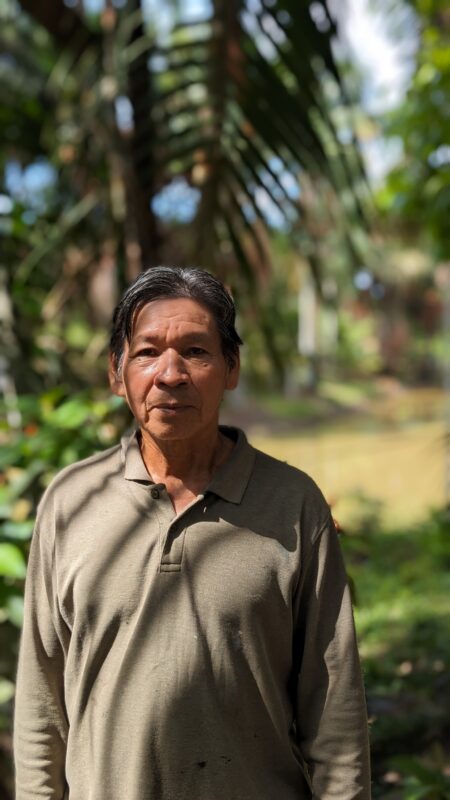
Santiago Yahuarcani paints with his family, using materials from the Amazon
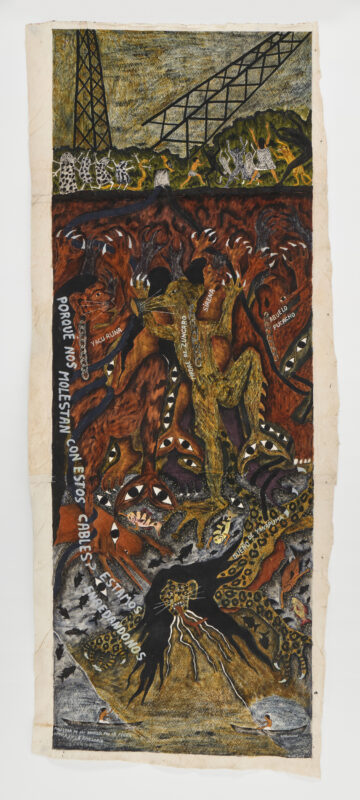
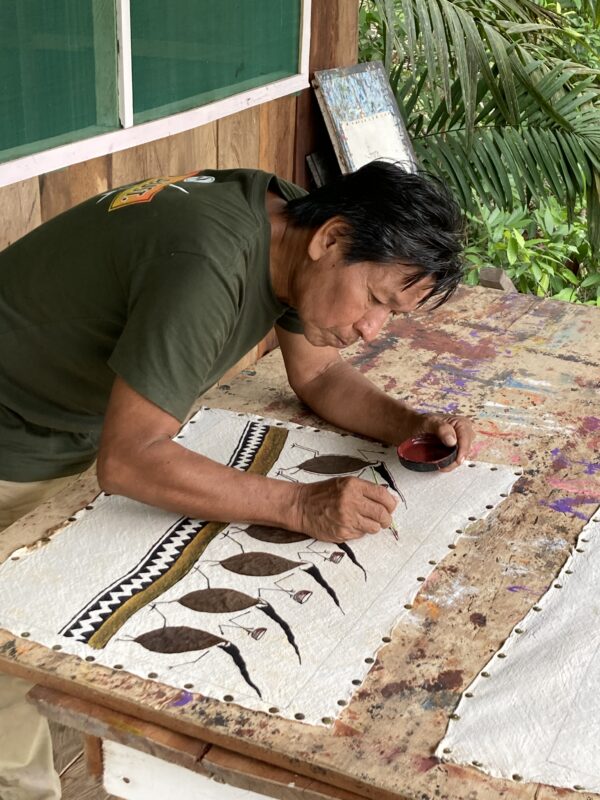
Rosa Chávez Yacila—When you were young, you painted small pictures of animals. Starting in the 2000s, you began painting about Uitoto customs, parties, and foods, and years later, about their worldview. How did that change come about?
Santiago Yahuarcani—In 2003, I was invited to an event in Lima, an art exhibition. Rember [Santiago’s son, also a painter] was my companion and traveled there with me.
Back then, we talked about cultural topics, and the two of us painted together. Up until that moment, we painted simple things like animals or Amazonian landscapes. When Rember went to this exhibition, people told him they were tired of Amazonian subjects, and that maybe it would be good to paint the festivals and customs of his own people.
In those days, my mother was very close to us and paid close attention to Rember’s travels. So, when she heard what I was talking about with Rember, she told him, “Well, son, that’s going to be your job. I’ll tell the stories here, and both of you will record them. But everything I tell you, don’t hide it, and don’t keep quiet about it either. Instead, you must share it wherever you go, so that people can learn about our customs, our stories, where we come from.” And I think all of that has worked really well, because that’s what we’re focusing on these days.
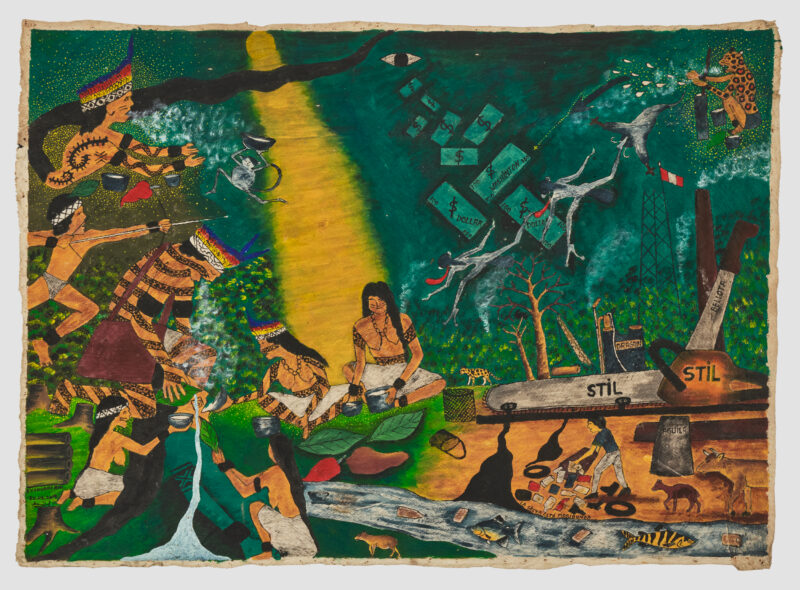
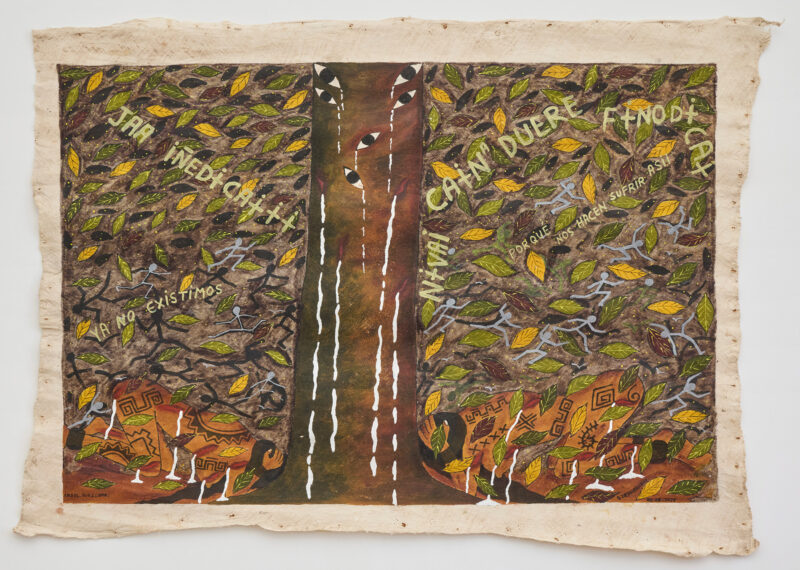
RCY—In a painting from last year, Malestar de los abuelos por la fibra óptica en la Amazonia (Grandparent’s Concern Over Fiber Optics in the Amazon), or another one from 2019, La selva está moribunda (The Jungle is Dying), you depict the current devastation of the Amazonian rainforests. Why have you decided to address these issues through your art?
SY—Our grandparents always told us that in the beginning of the world’s creation, the Almighty God, whom we call Buinaima, taught the Uitoto people to take care of nature. Our home is the jungle. Here we find fruits, medicine, food, and there are fish, birds, and animals. We must not destroy or mistreat the nature of these animals. If we want fish, we can fish what we will consume; we cannot abuse it until the supply runs out. Why would you want to depredate, destroy, or abuse all of this?
I think that’s what we need to teach our children and people nowadays, because there are many who see nature or the Amazon as a place where they can make money. They want to destroy the rainforests, the trees, and they want to sell them.
Those are the motives I sometimes set out to represent, so that the public can see how we’re trying to preserve our plants here. In other words, how our ancestors taught us from the very beginning. Our ancestors knew how to preserve nature.
RCY—You use natural materials to create your work. Could you explain to us what llanchama and piri piri are? Why are they so important to your work?
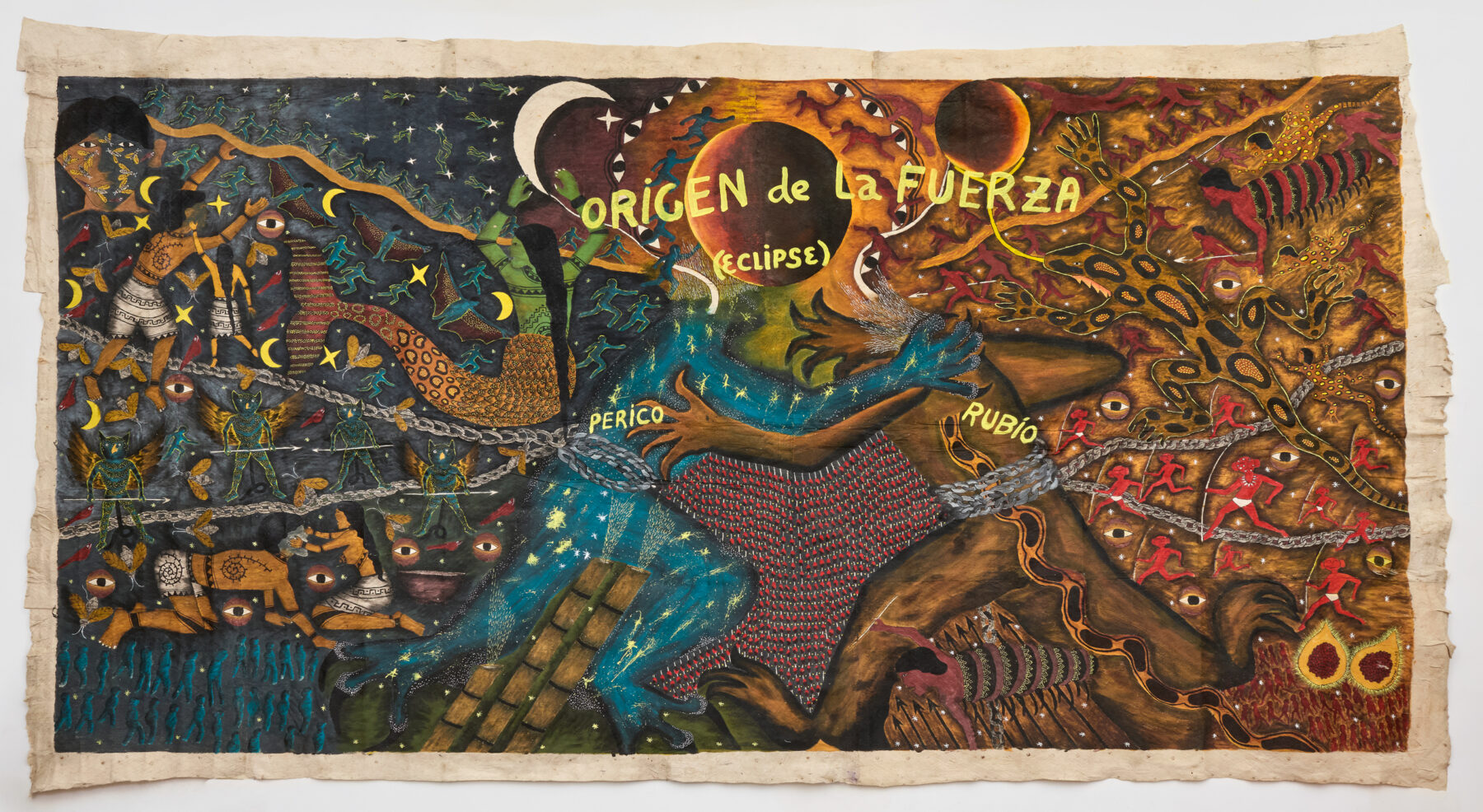
SY—Uitotos are a culture that doesn’t make thread or use cotton. They were wandering through the jungle, looking for something to cover themselves with. According to the ancestors, they were able to find a tree we call ojé. You cut down the tree and peel off the greenish bark because underneath there’s another layer of bark that’s sort of white. Then, using the flat side of the machete, you make X-shaped cuts, and this sort-of-white material gets ground down and turns into a fabric called llanchamama. This process takes two or three days, during which you can produce a meter of fabric to use for sewing. It’s very important because it’s a fabric extracted from a tree through chopping. There’s a process there.
In the beginning, our grandparents used llanchamama for dresses, sheets, hammocks, and to swaddle babies. I thought this fabric was very beautiful. Sometimes my grandfather would bring it out so white and it was just very pretty for you to draw on. And that’s how we came to paint on llanchamama.
Since I’m self-taught, back when I was a child there were no paintbrushes, no stores. We didn’t know what to paint with. We had never ever seen a paintbrush. But we had a little plant we called piri piri and we’d cut it to use. It’s like a pencil, but thinner. So we’d sharpen the tip, like a paintbrush. We’d paint with that. Even now I still use piri piri to draw my lines, to make other strokes. I’m not used to the paintbrush because it feels so soft; I can’t work with it.
RCY—And as for the natural dyes, which ones do you use?
SY—Here in the jungle, there are always fruit seasons. Right now, there’s a color that’s like a kind of navy blue that comes from a seed. I’m also using achiote seeds and guisador. Right now, there’s a palm tree called huasaí that has a violet color. I also use the green from the leaves. Now I’m taking advantage of this and creating my works using only natural pigments, doing everything entirely naturally. Sometimes I also use synthetic pigments, but I always see which one feels best. I’ve always liked natural pigments because they’re very rare. The colors are quite different from those of synthetic pigments.
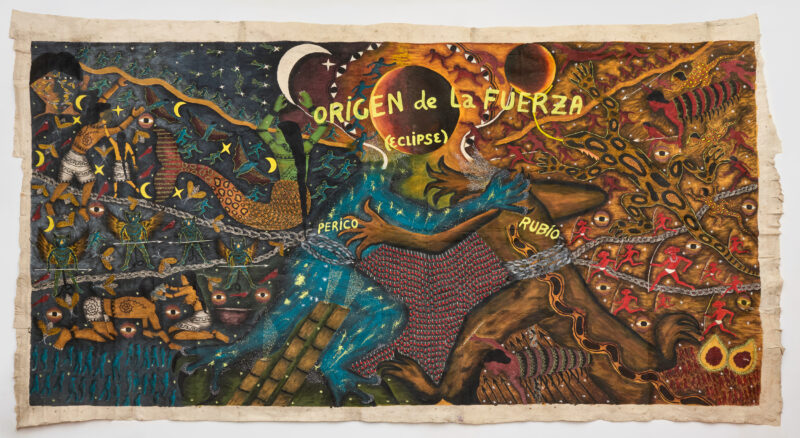
RCY—When we look at your paintings, we see creatures that seem half-human, half-animal; there are dolphins with legs, characters that look like monkeys, trees, plants… I mean, there’s a lot of imagination there. How do you come up with these images?
SY—When I was 16, I started taking ayahuasca with my dad and my brothers. It’s always been a family thing. During those ayahuasca sessions, I would get dizzy and start hallucinating very quickly. And that’s when I started to see these beings, insects, demons, anacondas… it was incredible; they can make you scream, they can make you cry, they can make you run. When I woke up on the second day, the things I had seen were etched in my mind. So I’ve been accumulating these visions.
With ampiri as well. Ampiri is the essence of tobacco, and it’s the other element through which I’ve been receiving these visions, the beings I’m depicting today. I’ve also taken some mushrooms that made me hallucinate.
There are certain illnesses that you have to cure in your grandchildren, in your children; you have to cure them with plants, with leaves, perform a ritual for them, say some prayers. All of that makes you dream at night. It’s a combination of various factors that inspire the ideas that I’ve captured on canvas today.
RCY—When you were a child, you worked with your father and your brothers. Now you work with your wife, your son Rember, but besides them, what other family members are involved in your artwork?
SY—We’ve gotten used to working as a family. For example, there are days when we have to harvest the llanchama. Then, we go to the chacra, the farm, we go into the jungle, and there we process the llanchama: my daughters, my grandchildren, everyone. Why? So that all the little ones can learn how the process works.
Once we have 20 or 30 meters of llanchama, we start painting. While we paint, my other daughter gathers the fruit, and another daughter goes to gather another kind of fruit. One daughter has to cut the llanchama into pieces, the other has to cook it, patching up any small holes left by twigs.
Then, when it comes to painting, we’re all painting together. My wife, Nereyda López, who is also an artist, prepares the pigments, or we discuss which painting we’re going to do next, and how we’re going to paint it. We talk about things among us and then we bring the piece to life. The whole family is involved in the creative process.
For example, there are times when I need to make small dots that don’t require much precision. That’s when I get my grandchildren—I have two small grandchildren, one is seven and the other four—to help me make the dots. They always want to get their hand in in every painting, but I tell them, “No, there will come a time when you’ll get to help.” So, to make sure they don’t feel left out because they’re eager to paint, I always set something aside so they can join in the painting too.
And when the artwork is finished, I gather everyone together to get their approval: what they think of it, whether they like it or not. Once the whole family gives their approval, we send the production on tour because it’s already been approved. In our view, this is an artwork that the audience is going to love.
RCY—I’ve had the opportunity to speak with some Amazonian leaders in recent years, and many of them fear the culture of Indigenous peoples is being lost. Some even mention that they don’t see any interest among the younger generations in preserving the knowledge of Indigenous peoples. How do you view this situation?
SY—It’s true that these values are being lost to a large extent these days. Young people are mostly moving to the cities in search of education, work, and new opportunities. As a result, they’re losing interest in these subjects. And it’s going to be impossible to stop this from happening.
It’s very painful. It’s a very sensitive subject to think about. The same goes for our language, food, our stories, our crafts. My children and I are always trying to work on these things, but it’s still going to be impossible to pass on everything. There are many things that my mother and my grandmother never told me. Those things have already been lost. But with what we have at our disposal, we continue to work on them as a family.
RCY—You have a Spanish name, but your name in Uitoto is Komu-illa Jitó, which means “son of growth.” How did you come by that name and how does it represent you?
SY—Our grandparents told us that we had a first name, but we had no last names. When you were born, they gave you a name, but once the Amazon rubber boom began, they started giving people the last name of their employer. That’s why most Indigenous groups have last names derived from their employers.
So, I was talking with my mom and my nephew, and they told me that my name was Komu-illa Jitó, which means son of growth. When you have a seed, say, an aguaje seed, you plant it on the ground, and it starts to sprout. Days go by, the rain comes, along with the moisture and the sun, and it begins to crack open and sprout.
My mom used to tell me that’s the name “so that you can grow in your life, so that you can be a person that contributes to your community”, but as you grow up, you start to drift in different directions.
RCY—You’re really living up to the meaning of your name. How does it feel to have your work exhibited in so many places, to be featured in these galleries and such important museums?
SY—Just thinking about getting to these places seems incredible to me, I can’t believe it. I’ve even been to Europe a few times and when I saw the exhibitions there, I couldn’t believe it. I can’t believe it, really, I just can’t believe it.
I never imagined I’d make it this far. But when I sometimes think about these things, about where I stand, I always remember my grandparents, my mom, my dad. I think about them and tell myself: if they hadn’t shared all the knowledge they had with me, if they hadn’t passed it on to me, I never would have made it to these places of such importance.
Someday I’d like to start an art school to teach young people everything I’ve learned along the way. I’d like to paint as much as I can, at a much lower and more relaxed pace. There are many subjects I haven’t explored yet, and I would like to paint them without rushing. As I see it, I plan to keep creating more, until my very last day, to paint until I die, and to die with a paintbrush in my hand.
Support for Art21’s READ comes from the Fleischner Family Charitable Foundation.
Interview conducted for Art21 in March of 2026 by Rosa Chávez Yacila, edited by Camila Palomino and translated by Bernardo Izaza Capdevielle. All photography courtesy the artist and Crisis Gallery.
Rosa Chávez Yacila is a reporter and writer. She covers stories on gender, inequality, and human rights. Her articles has been published in media outlets and magazines in the Americas and Europe, such as Ojo Público, El País, VICE, The New York Times, Granta. She works as a professor of Literary Journalism at the University of Applied Sciences. She is the author of “Las nerviosas” (2026).