In the Studio
Kent Monkman recasts history painting within a Cree worldview.
Andrew Woolbright—I wanted to start off by asking you how you feel about the term “world-building” as it relates to your practice.
Kent Monkman—I started to realize that I was in this world-building exercise when I sat down to write Miss Chief’s memoir. About seven years ago, I started that project with my co-writer, Gisèle Gordon. I had been creating paintings and doing performances with my character, Miss Chief Eagle Testickle but, when we actually sat down to fill in some of the blanks in her story, we realized that there were many unanswered questions. So that’s when the decisions were made to stitch her more intricately into a Cree worldview and the parameters of Cree cosmology. The book project furnished an opportunity to do that with advisors who are Cree language speakers and knowledge keepers: Dr. Keith Goulet, Gail Maurice, Dr. Belinda Daniels, and Floyd Favel. I think that the imagined world of Miss Chief fits very well into Cree worldviews because of the elements that are built into Cree storytelling that have to do with humor, sexuality, and the lack of shame around diverse sexualities.
AW—Your work takes a museological approach, and addresses the difficulty of approaching history, while acknowledging that history is always a simulation that is trying to get us to accept it for what it is through the image. Maybe we can start with this Cree worldview that is more interested in bewilderment or the in-between.
KM—I wanted to have a character that could basically explode these received notions of history that everyone learned in school and then introduce another way of looking at history that is profoundly Indigenous (I’m Cree, so I’m speaking from a Cree perspective), and offers a challenge to these easy ideas about how this continent took shape. Miss Chief is loud, and she’s in your face, and she is there to interrupt and to redirect.
I realized a couple of decades ago that museums were complicit in perpetuating the ideas that the settler artists had created about the story of this continent. Museums had us as Indigenous people still in our own wing, represented as people from a bygone era, a vanishing race, a dead culture. I was immediately trying to problematize that space. The work that I do with museums extends beyond just the exhibitions, because I’ve volunteered in a number of different capacities to create advisory circles on museum boards to affect change that way.
AW—You wonderfully navigate history painting as a genre that you’re able to trouble and invent within, but there are also your paintings that you do that directly include the Cree knowledge keepers. I’m wondering who some of these artists are that you feel you owe something to.
KM—Jaune Quick-to-See Smith, Robert Houle, Bob Boyer, Jane Ash Poitras, among others. In 1990, we had what became known as the Oka crisis here in Canada, in which Kanien’kehà:ka land protectors stood up to the Quebec government that was coming for the lands at Kanehsatake to expand a golf course. It resulted in a violent standoff with Indigenous land protectors in that community and the Quebec government. Filmmaker Alanis Obomsawin made a pivotal documentary about it that was also hugely influential. As Indigenous people, we are in positions of being dispossessed of our lands, having our cultures under assault through the boarding school system, and being treated like second-class citizens on our own land. So the work is inherently political. I’ve realized that land has been central to my work from the very beginning.
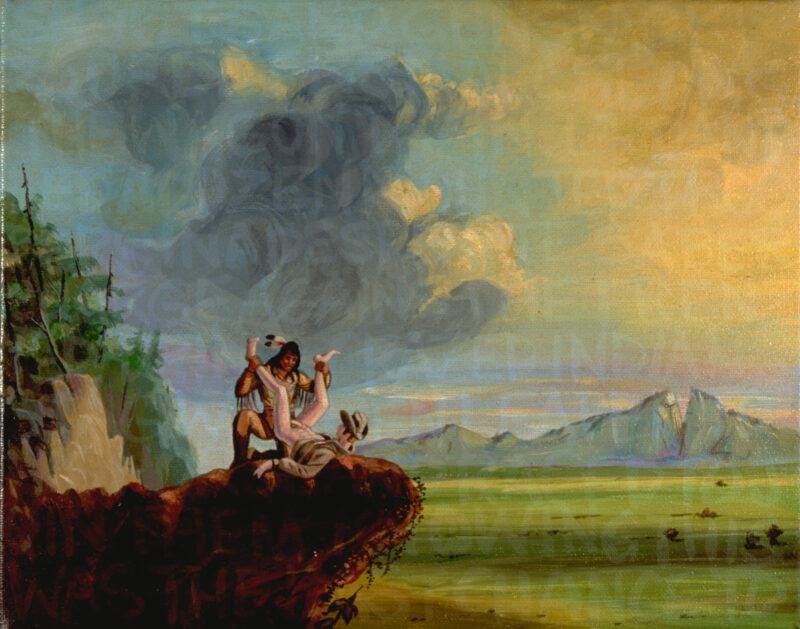
AW—Well, I also enjoy the ways that you confuse land and body. In Daniel Boone’s First View of the Kentucky Valley (2001), you subvert the tradition of Hudson Valley landscape painting by incorporating this erotic experience, an Indigenous person topping a settler. And it opens up this metonymic relationship to the history of this kind of painting: the pathologies of the colonizer, the fear of being subdued by the landscape, but also the ways it forms desire.
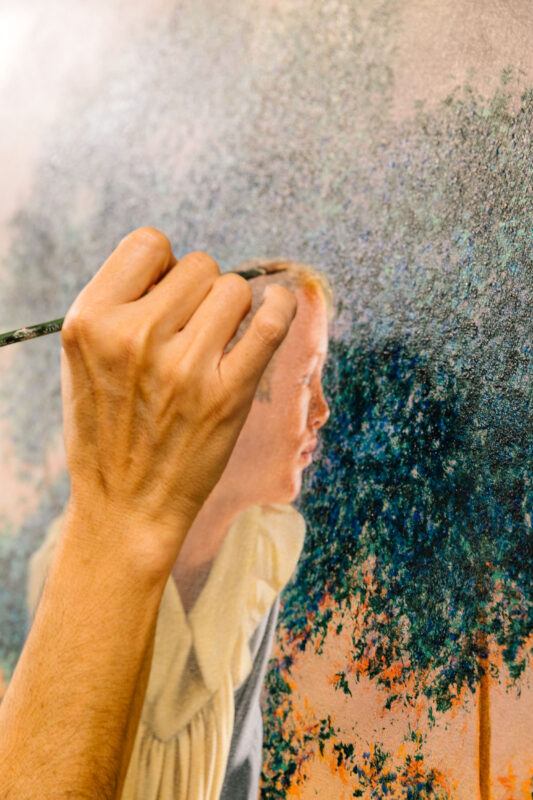
KM—I think those first images came from feeling like the settler gaze was a violent gaze. And despite their attempts to create these images of pastoral beauty and innocence in the North American landscape, Indigenous people were experiencing settler encroachment and were removed from our lands. At the same time, when settler artists were entering Indigenous communities, they were experiencing Indigenous understandings of sexuality and gender that they had never seen before, and their reactions were mixed—from abhorrence to curiosity to desire. That idea of power between the colonizer and the people that they were colonizing is the space of tension. And now, we have been in contact with each other for hundreds of years, and we have been exchanging with each other for hundreds of years, and we’ve been intermingling and intermarrying. That space between the cultures is often what I’ve been identifying in my work and is one reason why I moved towards a mark-making on canvas that at first glance appears to emulate a sort of settler-made painting as a way to throw people off balance.
AW—Something that occurs in your boarding school and the institutional paintings that you’re doing is something akin to what Saidiya Hartman talks about as critical fabulation, the attempt to create an image or a history where there isn’t an archive. But something else you do is always make us aware of the economy of manufacture behind what goes into the invention of historical images.
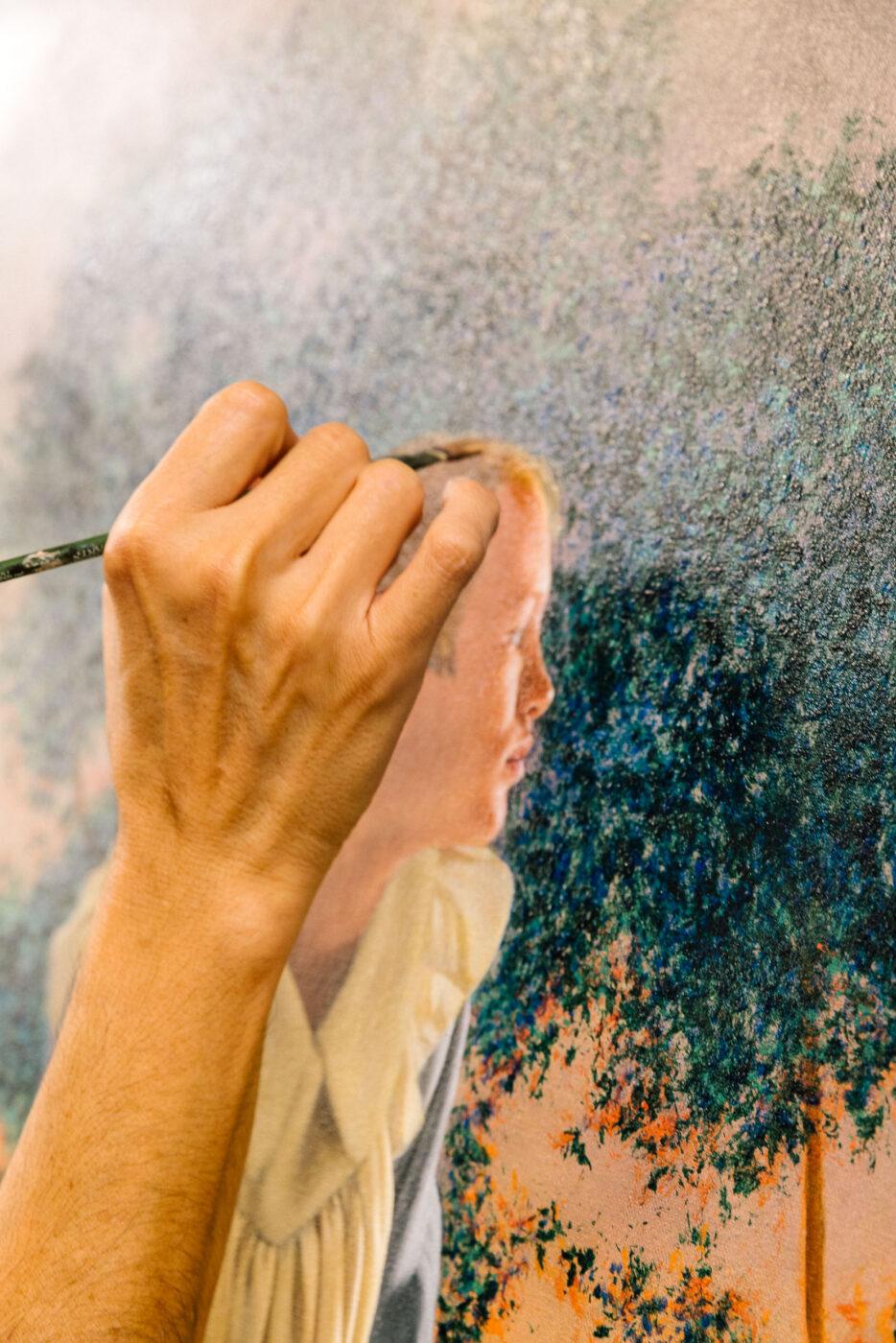
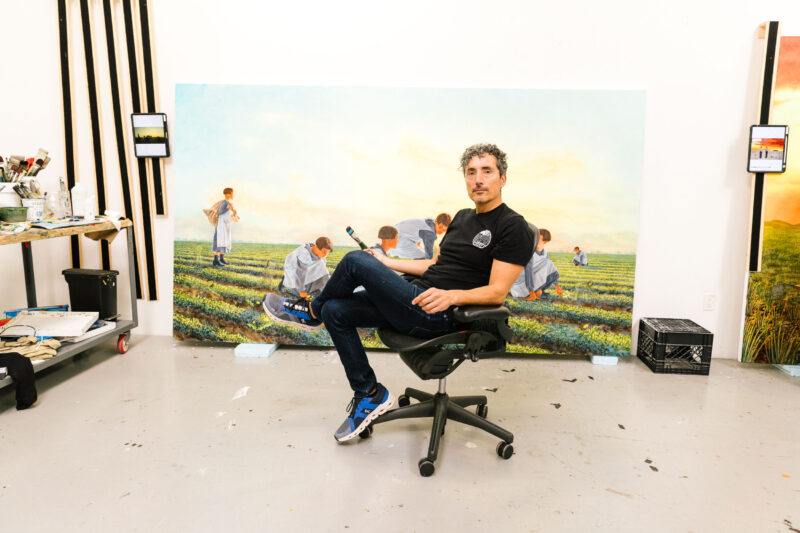
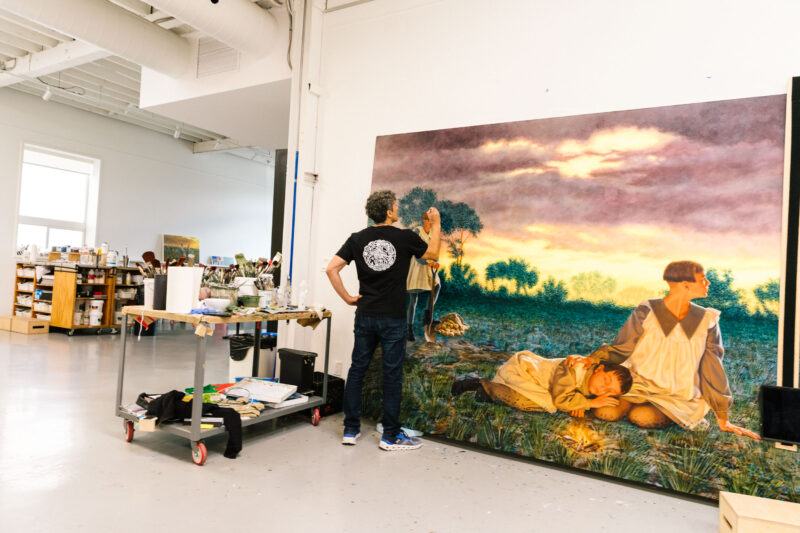
KM—Yeah, I think that that process for me of image making and constructing these images is just an interesting process, and it’s been employed by many artists over a couple of centuries or longer. I mean, the old masters would create drawings, and then they would make studies, and then larger paintings.
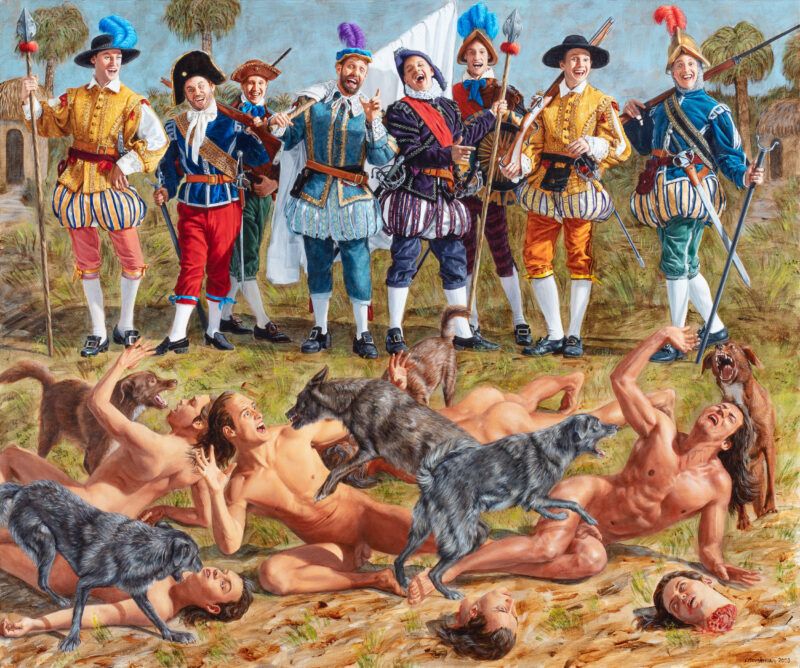
AW—The painting Study for Throwing Sodomites to the Dogs (2020) is a terrible scene. All of the white figures in the background have this almost George Tooker quality, this kind of copy-pasting of uncanny expression. But then the central figure, who is being viciously attacked by a dog, feels like an actor. It made me think of the concept of corpsing in relation to your work. Corpsing is a term within acting when an actor falls out of a role or is no longer believable in their role. David Marriott says that it is an “excessive body over representation” and that its “impure force, lies in the spectacle of what happens when the most self-present mastery of representation comes across that which is both unmasterable and unrepresentable.” It “denotes a failure to repress or the pleasure of failed repression, a pleasure that is also a death.”1 There’s a pleasure that is repressed within the genre of history painting that you are opening up within these excessive bodies.
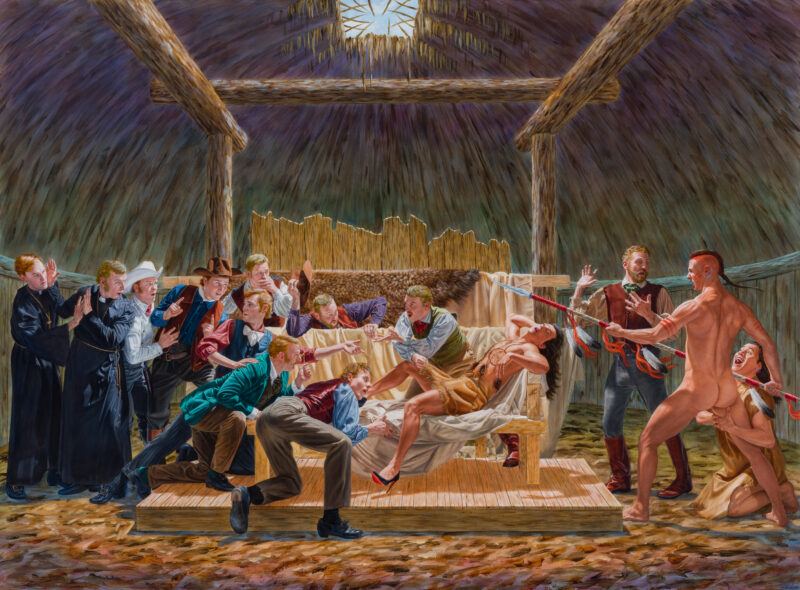
KM—I think, in understanding how painters would create images of conflict, there is this element of theatricality, almost like they are staged in the studio. This element of corpsing is a way of making people aware that I’m aware that this does look constructed and staged, because that is what I’m doing. I’m recreating and staging. The Examination (2020) is based on a historical event when anthropologists and medical doctors encountered a gender fluid Indigenous person, and multiple people were examining their genitalia. But then I put Miss Chief in that role of the person being examined. She has agency, and she’s not victimized. She is, in fact, controlling the entire scene, and it’s set up in a way to feel like it’s being staged. In that restaging comes that added element.
Giving people those little moments of self-awareness and that element of Miss Chief creating spectacle and performing is always there. I absent Miss Chief from certain images where I don’t want that distraction to happen, and often she’s absent from those images that reveal some of the harm and the trauma because I don’t want to diminish or trivialize them. I’ve created this aspect of her as a shapeshifter, where maybe she’s present as a sparrow or another animal.
AW—Miss Chief not only anchors the composition, but she gives you a place to rest. She’s a trickster, an ambivalent and unreliable Virgil, who is looking for opportunities to have fun and have her moment. Is that how you would describe her?
KM—Well, I think like a trickster character, she is flawed and she can undermine herself with her own desire, or her own self-interest, or her own vanity. I think incorporating that flaw is also a very Indigenous thing that comes through our storytelling traditions. And so, making her look a certain way and putting her in these Louboutin stiletto shoes means that there is something wonderfully ridiculous about it, which gives people a way out of—and a way into—these difficult subjects. A lot of my work is truth-telling, even though I’ve constructed this universe that is mythic. I want to give people a way out when I bring them in and deliver these harsh truths so that people can come into the work a little at a time, in layers.
AW—And that role of the trickster, even the detail of the Louboutin shoes, goes back to that methodology of corpsing, this excess of the body that supersedes representation. There’s something wonderful about Miss Chief saying I can still tell the story and be a witness while also finding her own pleasure within it.
So often when I think about world-building practices, I think of the role of speculation. You’re dealing with the past, and you’re dealing with the present, but how do you engage with the future?
KM—Well, in Cree worldview, the past, present, and future are all melded together, and we sort of exist in the past and in the future and in the present all at the same time. And this distinction of futurism, to me, it’s part of how we exist in the present and the past. I know some artists or Indigenous artists are very much into futurism, but, for me, it’s all melded together already. And the fact that Miss Chief is in these sort of 19th-century tableaus wearing Louboutin heels was a way of looking to the future by inserting her in the past, and it feels very present at the same time. So, I feel like by collapsing them all together, it works well with Cree worldview.
AW—And the pleasure and the humor that you utilize to disrupt and reinterpret sovereignty is the ability to find the joke and find the libidinal force, the errancy, the erotic within all this. You’ve taken the Cree understanding of unknowing and cast it into the visual genre of history painting to make the whole apparatus destabilized. It’s a genre that implies everything is known, and your disruption shows how baffling and ridiculous it is to accept what it has assumed.
KM—I think that’s a very Cree way of looking at the world—taking that certainty that exists in the Western world and in these images that are self-assured and then offering question marks or offering an alternate way of seeing the same moment in time, something that might help all of us right now.
Support for Art21’s READ comes from the Fleischner Family Charitable Foundation.
Interview conducted for Art21 in November of 2025 by Andrew Woolbright. Original photography for Art21 by Aaron Wynia. All additional photography courtesy of the artist.
Andrew Woolbright is an artist, gallerist, and Editor-at-Large at the Brooklyn Rail, living and working in Brooklyn, NY. Woolbright is an MFA graduate from the Rhode Island School of Design in painting and is the director of the Lower East Side gallery Below Grand. He currently teaches at Pratt and School of Visual Arts in New York.