Tommy Hartung's Underground Movies
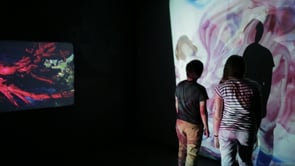
How little does an artist need in a moving image to tell a story? In this film, artist Tommy Hartung employs minimal means and materials to create animated movies, performing a series of experiments in his basement studio in Ridgewood, Queens. Hartung’s remodeled underground space functions as a workshop—or in the words of a friend, an “arena”—with colored lights, dioramas, and puppet-like characters.
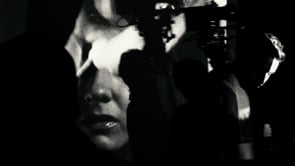
Using stop-motion photography, Hartung records a series of simple actions: blowing smoke through an artificial mouth, dripping Karo syrup on a frog, crumpling plastic wrap, adjusting a doll’s clothing, and funnelling salt through a hole. Preferring what the artist terms “dead cinema,” Hartung’s hand-crafted props and their intentionally un-lifelike movements are against the grain of current computer-generated animation spectacles.
Featuring scenes from the works The Story of Edward Holmes (2008) and The Ascent of Man(2009).
Credits
Art21 New York Close Up Created & Produced by: Wesley Miller & Nick Ravich. Editor: Mary Ann Toman. Cinematography: Andrew David Watson. Sound: Nicholas Lindner & Nick Ravich. Associate Producer: Ian Forster. Production Assistant: Paulina V. Ahlstrom, Don Edler & Maren Miller. Design: Open. Artwork: Tommy Hartung. Thanks: Candice Madey, Jorge Olivo, On Stellar Rays, Ronnie. An Art21 Workshop Production. © Art21, Inc. 2011. All rights reserved.
-

Tommy Hartung was born in 1979 in Akron, Ohio, and lives and works in New York. Growing up on a farm in upstate New York, Hartung spent countless days alone in the woods, building forts and living in a world of his imagination—which he considers the beginning of his artistic practice. Continuing to build fantastical worlds in his adult work, Hartung combines stop-motion animation and self-produced videos with found footage and cheap consumer technologies; all of his production sets are built in his studio using found objects.
“I sort of latch on to some kind of external theme, and then I just use that as a structure conceptually and then whatever kind of set or theater that I create in my studio is like this sort of physical space for that idea.”
Tommy Hartung