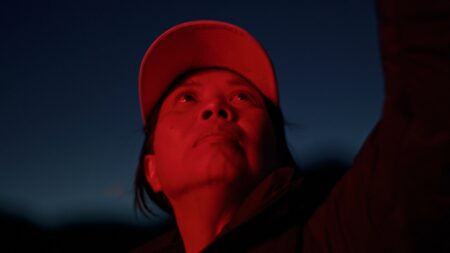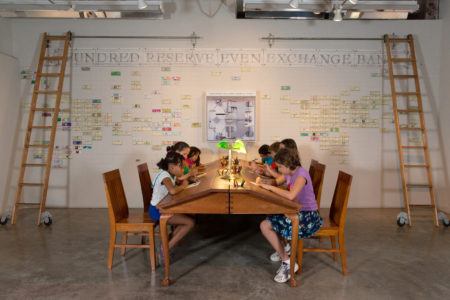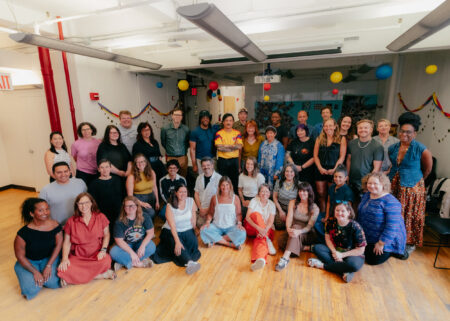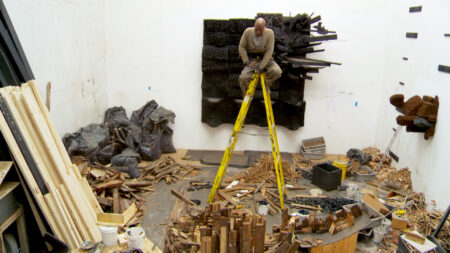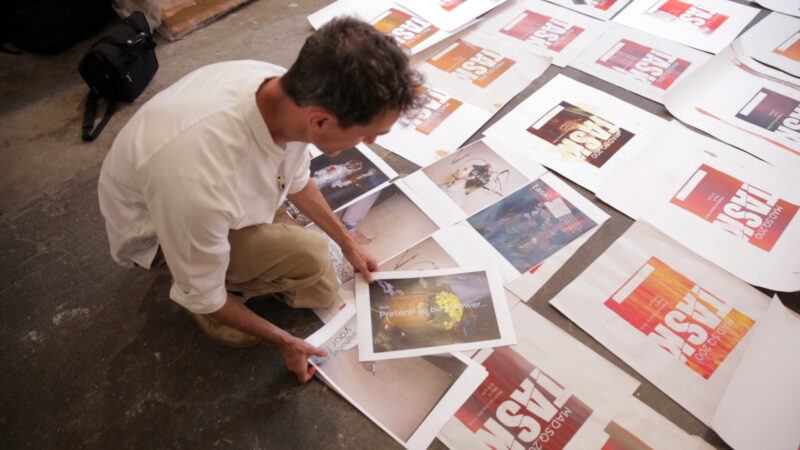
Production still from the Extended Play film, “Oliver Herring: ‘TASK.’” © Art21, Inc. 2014.
Last year Comedian by Maurizio Cattelan sold for $6.2 million at auction. The sale left many people, my students included, bewildered by how a banana duct taped to a wall could sell for more than an Upper East Side penthouse. A little over a hundred years ago, Marcel Duchamp also provoked onlookers when, at a prominent art exhibit, he unveiled his new sculpture Fountain, a urinal signed “R. Mutt.” Many people credit Duchamp’s piece as the beginning of the conceptual art movement. In conceptual art, the idea itself is the art. Exciting conversations about incorporating conceptual art into classrooms are at the forefront of art education. These conversations reimagine what it is to teach art in a contemporary landscape. This theory, while exciting, meets natural resistance in a classroom where students, families, and administrators are more familiar with traditional art forms. Contemporary art education calls for a critical engagement with ideas as well as the creative process. In this article, I share practical strategies for integrating conceptual art practices into the classroom.
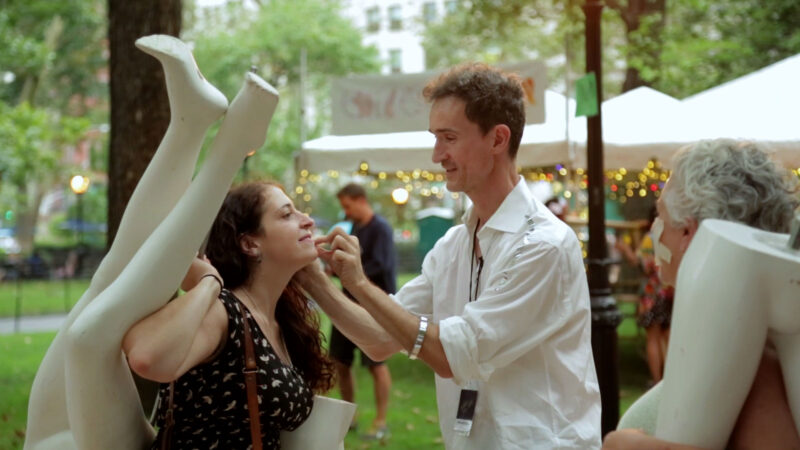
Production still from the Extended Play film, “Oliver Herring: ‘TASK.’” © Art21, Inc. 2014.
The first step to teaching conceptual art is helping students to understand that the idea is the art. Oliver Herring’s Art21 film “TASK” is an interactive art piece you can bring into your classroom to help enforce this. His written instructions, reminiscent of Yoko Ono’s Grapefruit, give the participant a short creative assignment. In Herring’s film, his party becomes a place where people are given permission to act creatively and connect with one another. His tasks can range from making yourself invisible to finding someone to play a game of tag with you. The playful nature of “TASK” elicits a range of ideas and reactions from people. See what kind of reactions you get when you allow students these same permissions! After a TASK Party it’s important to connect the activity to a larger understanding of conceptual art. You might have students discuss a closing question such as, “What are creative choices you made during the TASK Party?” or “What’s the difference between art and an idea?” Consider what questions are developmentally appropriate for the age group of students.
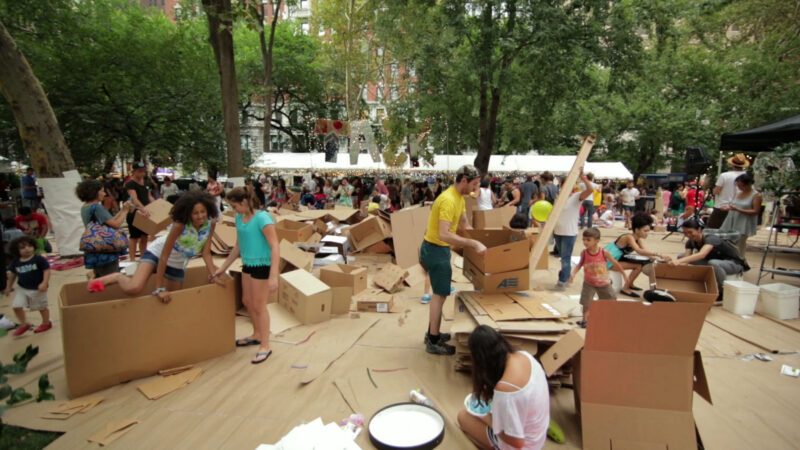
Production still from the Extended Play film, “Oliver Herring: ‘TASK.’” © Art21, Inc. 2014.
While it would be interesting to turn our classrooms into conceptual art fun houses, most schools value structure and measurable learning. Finding a balance between concept and technique helps to ensure you are nurturing the whole artist. In an attempt to achieve this, I incorporate an overarching question (or Big Question) for each of my projects. My hope is to help my students connect their art to a more abstract idea. Questions can be about identity, social justice, community, or anything else your students find meaningful. The question should be a touchpoint throughout the unit or lessons so that students are consistently engaged with it. I have students explore their big question while coming into class as a warm up, planning and reflecting. In my 7th-grade visual arts class, I explore abstract expressionism by using the work of Jean-Michel Basquiat. The techniques my students explore include mixing media, creating a balanced composition, and drawing Basquiat-style figures. After examining his work we discuss how Basquiat often conveyed messages of his emotions through his work. I challenge my students to express a feeling through imagery by prompting them with the question, “What is your experience as a middle school student?” As they interact with this question their newly learned technique is wielded through thoughtful answers. While not conceptual art in its purist form, helping students connect ideas to their artwork pushes them in the direction of making more meaningful art.
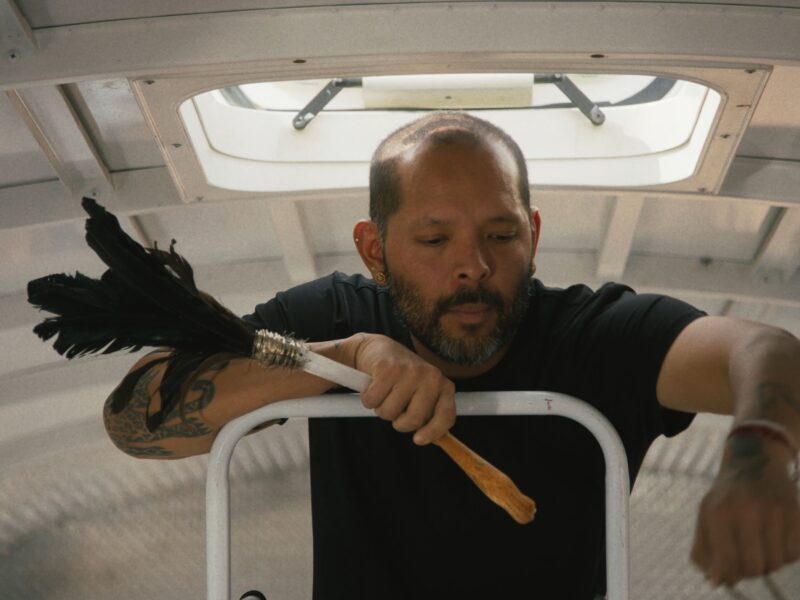
Production still from the New York Close Up film “Guadalupe Maravilla: Mariposa Relámpago.” © Art21, 2025.
Simply looking and talking about contemporary art is an incredibly powerful way to engage students with conceptual art. This can be done in small doses and doesn’t necessarily require entire classes. Fifteen minutes before a field trip, I showed students bits of Guadalupe Maravilla’s Art21 film, “Mariposa Relámpago.” We discussed what motivated Maravilla to make a healing bus and how he uses his art to address pain in his community. Short and casual engagement with conceptual art helps acclimate students to the idea that art is living. It is more than a 2D or 3D form. Furthermore, I believe it’s helpful when artwork comes with context. One major complaint I hear about conceptual art is that people don’t connect to it—they see something and are unsure what they’re supposed to ‘get’ about it. We can help students make more meaningful connections by sharing stories about the artist, processes, or about the pieces themselves. Hyeree Ro invites us to see her process in her film, “Precise Ambiguity,” and recounts a road trip with her father. While Ro does not explicitly explain what their sculpture ‘is about,’ the context given by the film helps us to view the work in a way we might not have originally.
Anyone is capable of engaging with conceptual art. In its nature, conceptual art can be democratizing. Let’s let our students become a part of the discussion which has so far been saved for academics and curators. Resources such as Jorge Lucero’s book What Happens at the Intersection of Conceptual Art & Teaching? and Art21’s educator resources can be helpful in the continuation of this work. As art evolves may our classrooms evolve with it!
Genavie Williams is an artist-educator dedicated to the belief that art is a tool for connection. Throughout her career, she has shaped visual arts programs in San Francisco and New York City. Her teaching philosophy is rooted in contemporary practice, encouraging students to view their world through the lenses of observation and questioning.
Williams’ own artistic practice, gdubartista, focuses on place, attention, and presence. By engaging with these themes—on exhibition at 168 Thompson St. in downtown Manhattan—she models a life of active exploration for her students. Her work is a testament to the idea that the classroom and the studio are interconnected places for expression.