Julia Soderholm is an artist & art educator based on the unceded territories of the xʷməθkʷəy̓əm (Musqueam), Sḵwx̱wú7mesh (Squamish), and səlilwətaɬ (Tsleil-Waututh) peoples, also known as Vancouver, British Columbia. She is an Art21 Educator and has taught elementary school art in Vancouver for the past eight years. Julia is committed to practicing culturally responsive and relevant pedagogy in her classroom, and has found contemporary art to be an exciting way to share both “windows and mirrors” with her student community. Alongside teaching, Julia is currently pursuing her MFA at Emily Carr University of Art and Design in Vancouver.
Teaching with Contemporary Art
Observation as a Radical Act
Courtesy of Julia Soderholm.
Is there inherent value in the act of paying attention? What does it take to observe something closely? How does an object, person, or place change when attention is given to it?
These questions are at the heart of my teaching practice, both when considering the attention I pay to my work as an educator and in the kinds of learning experiences I design for my students. The truth is that paying attention requires work, and, in my experience, it has become more challenging than ever to practice it. This is why embedding observation into the art classroom is a valuable and ever-fruitful exercise that offers young people the chance to embody this type of contemplative posture.
Courtesy of Julia Soderholm.
Firstly, to observe something closely is to attend to it. The poet Mary Oliver wrote that “attention is the beginning of devotion.” In other words, what we pay attention to shapes us. For so many of my students, attention can be a fraught thing—they are pulled in many different directions on any given school day. I am interested in how the art classroom can provide an opportunity to rest, be present, and offer students a chance to enter a different state of being while at school.
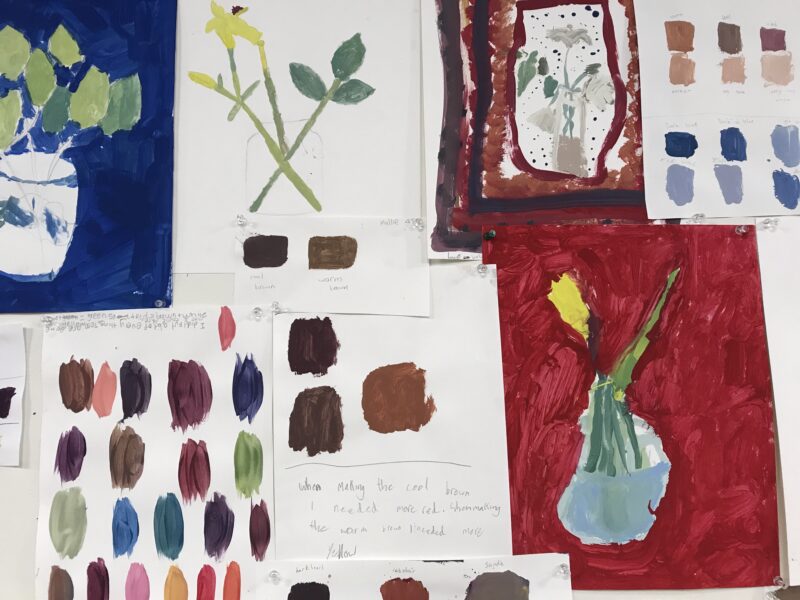
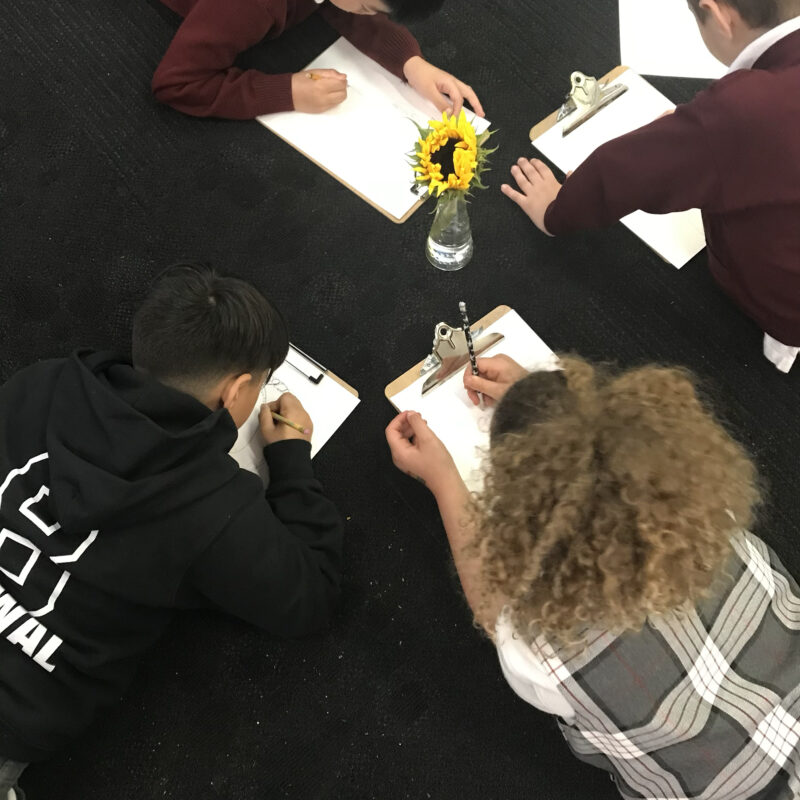
One way we practice this in my classroom is through observational drawing. Regardless of the grade I’m teaching, I often begin the school year with a short drawing unit. We cover the basics—blind contour drawings, continuous line drawings, and so on. These exercises are classic for a reason. My students are constantly surprising themselves when they slow down, trace the outline of an object with their finger, and remind themselves to “draw what you see.” It’s a meaningful way to begin the year because it builds confidence and shows these young artists what they are capable of when they take their time. In this case, the art classroom becomes a place where observation and attention take the form of slow looking, patience, and iteration. Draw the leaf, and then flip it over and draw it from a new angle.
Courtesy of Julia Soderholm.
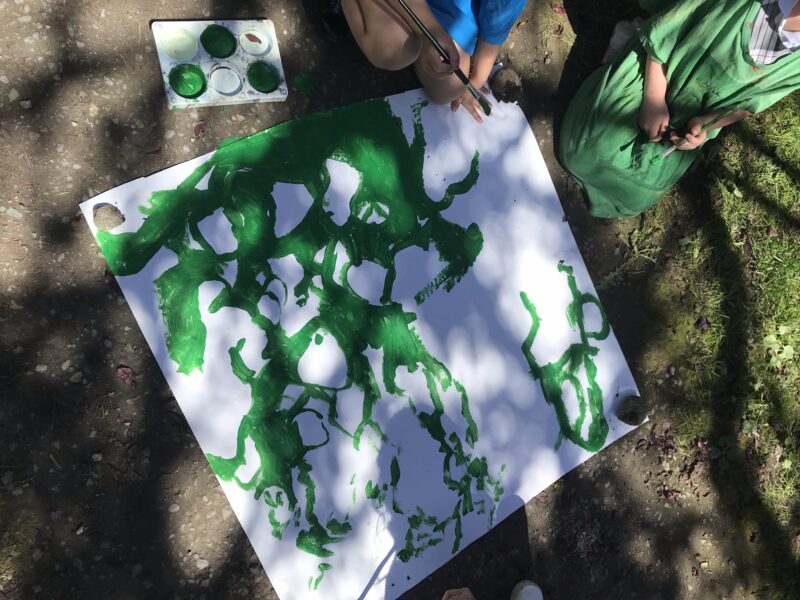
In my own art practice, I’m interested in the way that observing something impacts one’s relationship to it: the tree across the street from the school becomes meaningful when we learn that it is an oak tree, that northern flickers nest in it, and that the acorns collected at recess fall from its branches. When we draw that tree, its leaves, or the birds that live in it, we develop a relationship to it and deepen our connection to the place we live. My hope is that the practice of observational drawing offers my students the opportunity to develop these kinds of grounding connections in their own lives and artwork.
Another way my students practice observation in the art classroom is by looking closely at the artwork of others. This year, my Grade 4 students investigated the work of Hank Willis Thomas. Through watching his segment from the “Bodies of Knowledge” episode, we learned about the way that the artist considers photography as the ultimate excuse for looking closely.
Often, when approaching a new artwork in class, we use Project Zero’s “Visual Thinking Routines.” These familiar exercises offer structure through which to engage with a new image or idea. For example, when looking at Hank Willis Thomas’s photograph, The Cotton Bowl, the students used “See Think Wonder” as a framework from which to read the image. They begin the exercise by writing down everything they see (helmet, grass, plants), then move on to writing down what they think about what they see (I think that is a football player, I think the plant is cotton). Finally, in the Wonder section, students record their questions: Why are there two people facing one another? How are they related? After the exercise, we begin a class discussion using these notes as a starting point. This routine, and others like it, help us break our looking down into smaller components. I try to use this practice myself when looking at artwork that feels abstruse or unfamiliar at first glance—it helps open the door to deeper engagement with the work. This kind of attention is vital for students to develop their visual literacy, not only when looking at artwork, but more broadly.
Courtesy of Julia Soderholm.
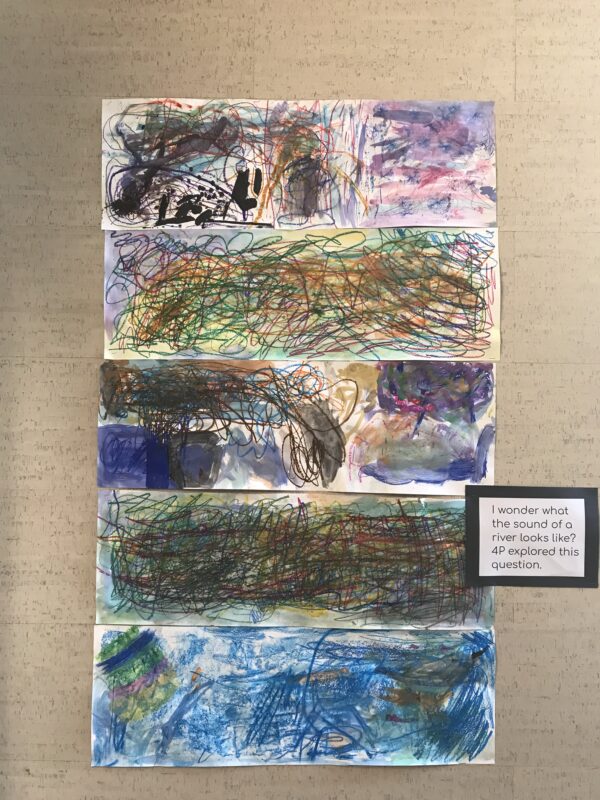
Finally, there are times when the thing we are observing in the art studio may not be visible at all. For example, in a unit exploring different modes of drawing, students moved away from the observational and towards an expressive approach to mark making. The question we were exploring was how artists render the invisible visible. For this unit, the work of Christine Sun Kim offered a rich investigation into these ideas, particularly in the “Friends & Strangers” episode. The students responded to this idea by listening to music and making marks that corresponded with it. Next, they listened to the sounds of a river and responded to that through abstract drawing. Although not strictly observational, these drawing practices require the students to attend closely to something using their senses and to create a response, offering another opportunity for students to practice being both present and improvisational in the art classroom.
In a time where one’s attention is often contested, art provides an opportunity to slow down and practice being present. My hope as an art educator is that my students will grow up valuing the feeling of creative flow that time in the art studio offers. Through the practice of observation and attention, I believe that young people can develop tools for a more grounded, creative, and connected way of moving through the world around them.