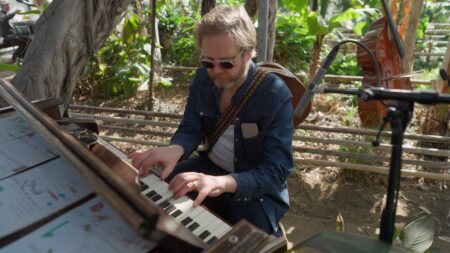
Ragnar Kjartansson
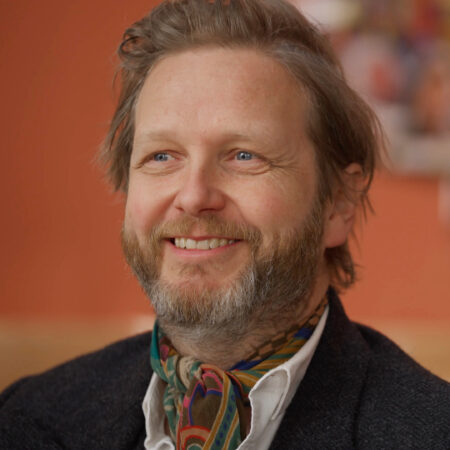
Ragnar Kjartansson was born in 1976 in Reykjavik, Iceland, where he lives and works. He studied at the Iceland Academy of the Arts, Reykjavík, Iceland, from 1997 to 2001, and spent a year studying at the Royal Academy in Stockholm, Sweden, in 2000. Through performance, music, video, drawing, painting, and sculpture, Kjartansson explores humanity’s fundamental concerns, from myth-making and national identity to love and beauty. Engaging with the history of music, television, and performance, the artist employs simple yet effective strategies, such as repetition and extended duration, to transform everyday experiences into profound works of art that resonate with the human condition.
Across media, Kjartannson uses repetition and duration as tools that hint at the beauty, banality, and sanctity of the human experience: repeating the performance of a single song for over an hour in his nine-channel video installation The Visitors (2012), creating 1,000 porcelain pepper shakers for the installation Guilt and Fear (2022), or staging a twelve-hour performance, Bliss (2009), which repeats a single scene from Mozart’s Le Nozze di Figaro. “I really like this idea of repetition, it creates a mantra,” says the artist. “It just becomes mystical…like a religious experience.” In works like Me and My Mother (2000–ongoing), the artist records a video of his mother spitting on him once every five years, documenting the passage of time and the changing relationship between mother and son. Other works, like Romantic Songs of the Patriarchy (2018) and The Sky in a Room (2018), reproduce songs from popular culture like Bruce Springsteen’s Fire and Gino Paoli’s Il Cielo in una Stanza to give new meaning to recognizable lyrics and tunes. In Romantic Songs of the Patriarchy, the artist invites women and non-binary singers to perform popular songs written by men about women, simultaneously revealing the objectification inherent in these songs and creating a space for reclamation and joy.
Kjartansson frequently produces works that deconstruct markers of identity, such as nationality, profession, and gender. During his six-month performance at the 53rd Venice Biennale, called Venezia, The End (2009), the artist transformed the Icelandic Pavilion into his studio, where he painted numerous portraits of his friend Páll Haukur Björnsson in a Speedo. The performance evoked tropes of the singular genius artist and the nude subject, rendering them absurd through repetitive performance. “I am kind of the ultimate cliché in art history: I am a white male wanting to be an oil-on-canvas painter,” says Kjartansson. “[I’m] learning how to have fun with that identity, and also use it as a criticism.” In his series of videos Scenes from Western Culture (2015), the artist portrays idyllic scenes of Western life: a couple eating dinner at an upscale restaurant, upper-class children playing in a garden, and a woman swimming laps in a pool. Removed from any larger narrative, these scenes of banal daily life are both familiar and, for many, distant, softly questioning a viewer’s desire to inhabit these scenes and the culture that produces them. Throughout his practice, Kjartannson uses quotidien scenes and pop cultural forms to reflect on what it means to make and experience art, and what it means to be human.
Videos
Trailer
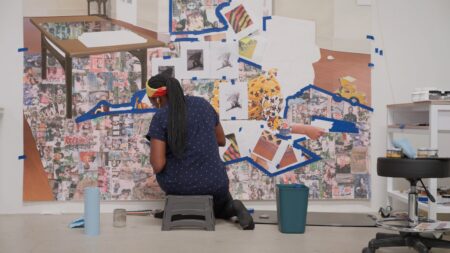
“I am kind of the ultimate cliché in art history: I am a white male wanting to be an oil-on-canvas painter. [I’m] learning how to have fun with that identity, and also use it as a criticism.”
— Ragnar Kjartansson