Julia Soderholm is an artist & art educator based on the unceded territories of the xʷməθkʷəy̓əm (Musqueam), Sḵwx̱wú7mesh (Squamish), and səlilwətaɬ (Tsleil-Waututh) peoples, also known as Vancouver, British Columbia. She is an Art21 Educator and has taught elementary school art in Vancouver for the past eight years. Julia is committed to practicing culturally responsive and relevant pedagogy in her classroom, and has found contemporary art to be an exciting way to share both “windows and mirrors” with her student community. Alongside teaching, Julia is currently pursuing her MFA at Emily Carr University of Art and Design in Vancouver.
Teaching with Contemporary Art
Sound & Performance: Exploring performance art in elementary school
Courtesy of Julia Soderholm.
One of the most exciting parts of teaching art to elementary students is their implicit open-mindedness when it comes to creativity. Before lines have been too sharply drawn between what is art and what is not art, young children are experts at asking questions, exploring materials, and approaching new ideas with a spirit of play. One of my goals when participating in the Art21 Educators Program was to find ways to further bring conceptual art into my teaching, giving these young artists a full spectrum view of what contemporary art can entail. It was with this understanding that a unit exploring sound and performance art was developed with Grade 2 students in mind.
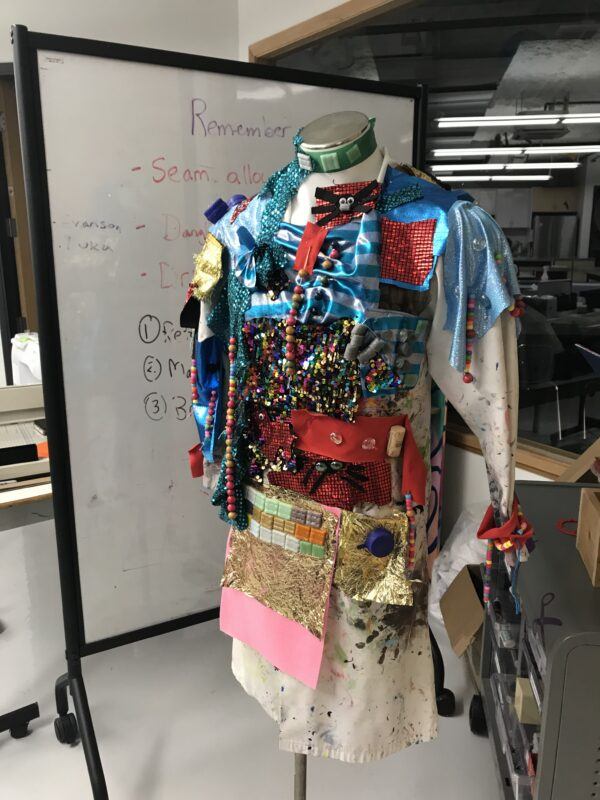
I had been interested in exploring Nick Cave’s “Soundsuits” in class for some time. I knew that the tactility of the material and the playfulness of these works would appeal to the primary grades in particular. The themes of sound and performance offered a broad enough umbrella to investigate a variety of ideas, such as wearable art, video art, and found objects as materials. Alongside Nick Cave, we explored the work of Cannupa Hanska Luger, particularly his Future Ancestral Technologies (2018–ongoing) series. Both of these artists offered exciting examples of how art can be living, moving, and embodied—watching videos of the work in action was particularly important for the students.
This year, I taught alongside visual artist Zoe Ann Cardinal Cire in her role as Artist in Residence at my school. Zoe is an artist of Cree and Métis descent who grew up on Treaty 6 territory in central Alberta. She was integral in both the unit planning and co-creation of the work with the students. Zoe shared another connection with the students regarding sound and performance by teaching them about Jingle Dress Dance, a healing dance that originated from the Ojibwé people. We looked closely at images of Jingle Dress regalia, whose source of sound comes from metal jingle cones sewn onto the fabric.

Courtesy of Julia Soderholm.
The unit began by prompting students to create a “Wonder Wall” of questions regarding the “Soundsuits.” Many of their questions were practical: Is it hot inside the suits? How can people get into the suits? Can they breathe? Another line of questioning began around how the suits are made and what materials are used to make them. This began the first step of our learning process: exploring materials. Zoe and I collected a wide range of found objects and fabrics for the students to touch, crinkle, and experiment with. How could these materials make sound? What kinds of textures could they create?
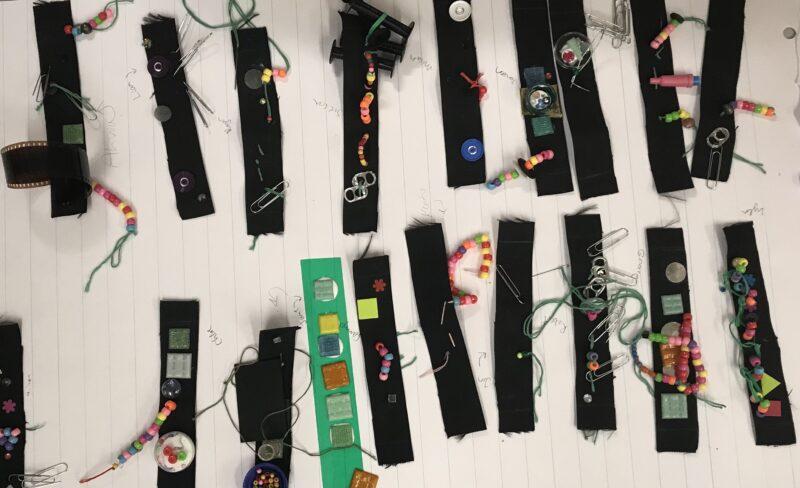
Next, we had to consider the logistics of our project. With a large class of students, we had to ask ourselves how realistic it would be for each child to create their own “Soundsuit.” For our circumstances, we decided to create two “Soundsuits” collaboratively. Alongside the two suits, students also created individual Sound Bracelets. The bracelets were their stepping stone into considering how to attach materials to fabric, as well as how the various materials would sound when moved. Zoe showed students the process of attaching a jingle cone to fabric and helped each student attach a cone to the collaborative project.

Courtesy of Julia Soderholm.
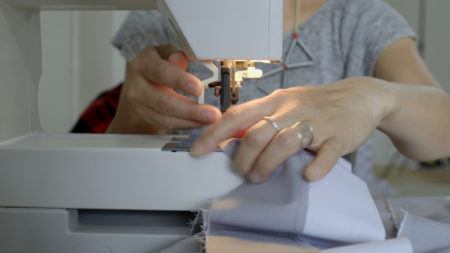
When it came to creating the actual suits, we set up two stations in the art room. At one station, Zoe worked with students to attach jingle cones and beads to a garment that she had created in advance. At the second station, students worked on creating individual patches to be sewn onto the suit later. These patches consisted of anything from sparkly fabric to plastic cup lids to mosaic tiles. Once we had collected enough patches, Zoe sewed them into a second garment, resulting in two unique Sounduits at the end of the unit.
Finally, we considered how we could take the concrete work of the Soundsuits and Sound Bracelets and add an element of performance for our second graders. This is where video art came into the unit. We filmed each student dancing or moving while wearing one of the Soundsuits in front of a green screen. Each film lasted about 5 seconds—just enough to capture the sound created by the suit. We then prompted students to create an abstract watercolour painting that described the sound made by the suit. The final piece resulted in a film looping all of the students’ individual performances over the background of their abstract paintings. A teacher at our school created a soundtrack for the video, using the sound of the jingle cones as the basis for the beat.
Courtesy of Julia Soderholm.
This unit was a learning curve, both for myself as an educator and for my students. We took our time, gauging student interest and attention when exploring and building these works. We spent many classes playing with materials, without a more traditional approach of teacher demonstrations. We heavily emphasized the idea of exploration, experimentation, and play. It was exciting for students to engage with art-making using something beyond traditional art materials and to create work that pushed the boundaries of what they had made before. They were excited to see their work and their performances in video format, and proud to share with a wider audience. The video and the “Soundsuits” were eventually included in a school-wide fashion show, which took place later in the year, really completing the performance element of the project.
Introducing young people to unfamiliar art mediums is exciting and generative. The students took this conceptual project in stride, never once questioning whether dance, sewing, found objects, or green screens should fall under the fine art umbrella. I’m grateful for the ways that contemporary artists help to remind us that art can be about exploration, play, and experimentation.