May Makki conducted the interview for Art21 in July 2026. Photography by Alvise Busetto. Courtesy the artist and Visual Arts Commission, Ministry of Culture of Saudi Arabia.
In the Studio
Dana Awartani honors craft traditions

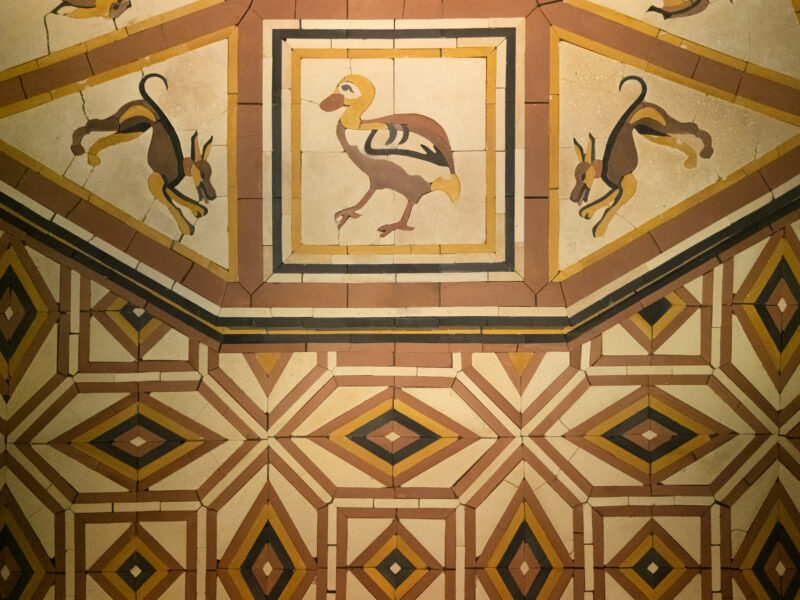
May Makki—For over a decade, your work has been invested in the politics of cultural heritage. Can you take me back to where that interest began? Was there a particular moment or experience that first made you think about cultural heritage in this way?
Dana Awartani—Everything has led me here, from my lived experience to my formal education. First of all, I have mixed heritage: I’m from bilad al-sham [the Levant] but also from the Gulf. My sense of identity was always a big question for me, especially amongst people who are very nationalistic. My parents are Palestinian, Syrian, Saudi, Jordanian, and I have a kinship to all those places.
When I went to do my Bachelor’s at Central Saint Martins, I was one of the only Arabs in the program. My tutors, teachers, and peers had a very rigid perspective on what it means to be Middle Eastern or Arab, and a woman. I didn’t necessarily relate to their references, which were anchored in being a refugee, being oppressed, or being related to conflict. I had just read Edward Said’s Orientalism for the first time, and it resonated with my feeling: “isn’t there more to us than that?” It gave me a lens for understanding how they understood and fetishized the “region” and me.
In a way, this experience turned me off from contemporary art. For my Master’s, I ended up studying at the Prince’s School of Traditional Arts. It was the opposite of my undergrad experience, which focused on critical thinking and research but not much on materiality. On my first day, they told me, “You’re not coming here to be an artist. You’re going to be a craftsman for two years.”
I developed a deep love and respect for the rigor and discipline behind material lineages. That’s precisely why craft traditions have lived on for centuries. Still, while I felt that it was incredible to have learned from these traditional techniques, they were very much stuck in time.
It took me several years after graduating to feel ready to experiment with these craft techniques while still giving respect to the form. You can’t innovate before being a master in your medium. Who am I to do a year or two of training and then do whatever I want with it? So, I continued on to do an ijaaza in Istanbul in manuscript illumination, which is a very traditional way of apprenticing with a master that predates Western university structures.
After that, I finally felt ready to merge the traditional craft training and the contemporary thinking I had honed at Saint Martin’s. Beyond the technical, craft spoke to my unanswered identity questions. Because, if we look at something as simple as sacred geometry in Islamic art, there is no such thing as Syrian sacred geometry, Palestinian or Saudi: it’s shared. It transcends religion, borders, and nations.
I found that this kind of pre-colonial way of looking at the Arab world, when we weren’t divided by borders, when we were different cities with different cultures but still shared so much, gave me a new way of understanding my own history. It’s the same if you look at our food culture: Syrian, Palestinian, Jordanian, and Lebanese are all very similar, and it’s the same thing with our traditional crafts. Of course, there are examples of distinctive crafts, like tatreez from Palestine, mother of pearl in Syria, or inlay work in Morocco or India, but these broader connections made me look at my own history in a more nuanced and optimistic way.
MM—Cultural destruction is another way to see across a larger swath and observe certain connections, right? I’m interested in when you choose to be really specific and explicitly name locations, like sites in Gaza destroyed by the Israeli Occupation in December 2023, versus when you zoom out and reflect on broader patterns, or the massive weight of ongoing destruction in different iterations of Let Me Mend Your Broken Bones (2023–present). How do you decide which approach to take? Has it been an evolving conceptual position?
DA—It varies for every project. The first project I did that looks at cultural destruction was the video performance I did with the sand, I Went Away and Forgot You. A While Ago I Remembered. I Remembered I’d Forgotten You. I Was Dreaming. (2017). Much closer to home for me, it looked at Al-Balad in Jeddah. Generally speaking, when you look at modern architecture across the Gulf, it’s quite divorced from the vernacular architecture of the place.
Starting in the late 1950s and early 1960s, rich families living in Al-Balad were building homes in these European styles. At the time, I think because of British, Italian, and French colonial rule in the region, they felt that emulating Western culture made them more refined or prestigious, old homes were being purposefully abandoned. For example, traditional homes were built with a specific stone that had natural cooling properties. Today, all modern buildings here and across the Gulf are built with concrete, and you cannot live in them without AC. So with this purposeful abandonment and self-colonization, important knowledge from our ancestors was lost.
I did a performance in one of the first houses built in one of these Western styles. After that, I started looking at other forms of purposeful destruction. When I started the series Come, Let Me Heal Your Wounds (2019-ongoing), I wanted to archive all sorts of purposeful forms of man-made destruction, especially thinking about cultural cleansing by Daesh, Al-Qaeda, and different kinds of terror organizations that were, in a sense, trying to reduce the Middle East to one kind of homogenous identity and one idea of Islam, which isn’t true of who we are as a people. There’s diversity within Islam, and across our region there are Christians, Jews, Ismailis, and many different religions and cultures.
For that work, there were over 350 sites. It was loosely geographically laid out to represent the region, but I didn’t want it to be a map because I felt that isn’t what’s important for the work. What’s important is to see the sheer gravity of the destruction rather than where it is specifically. In the text of the work, I reference countries, but not the specific monuments.
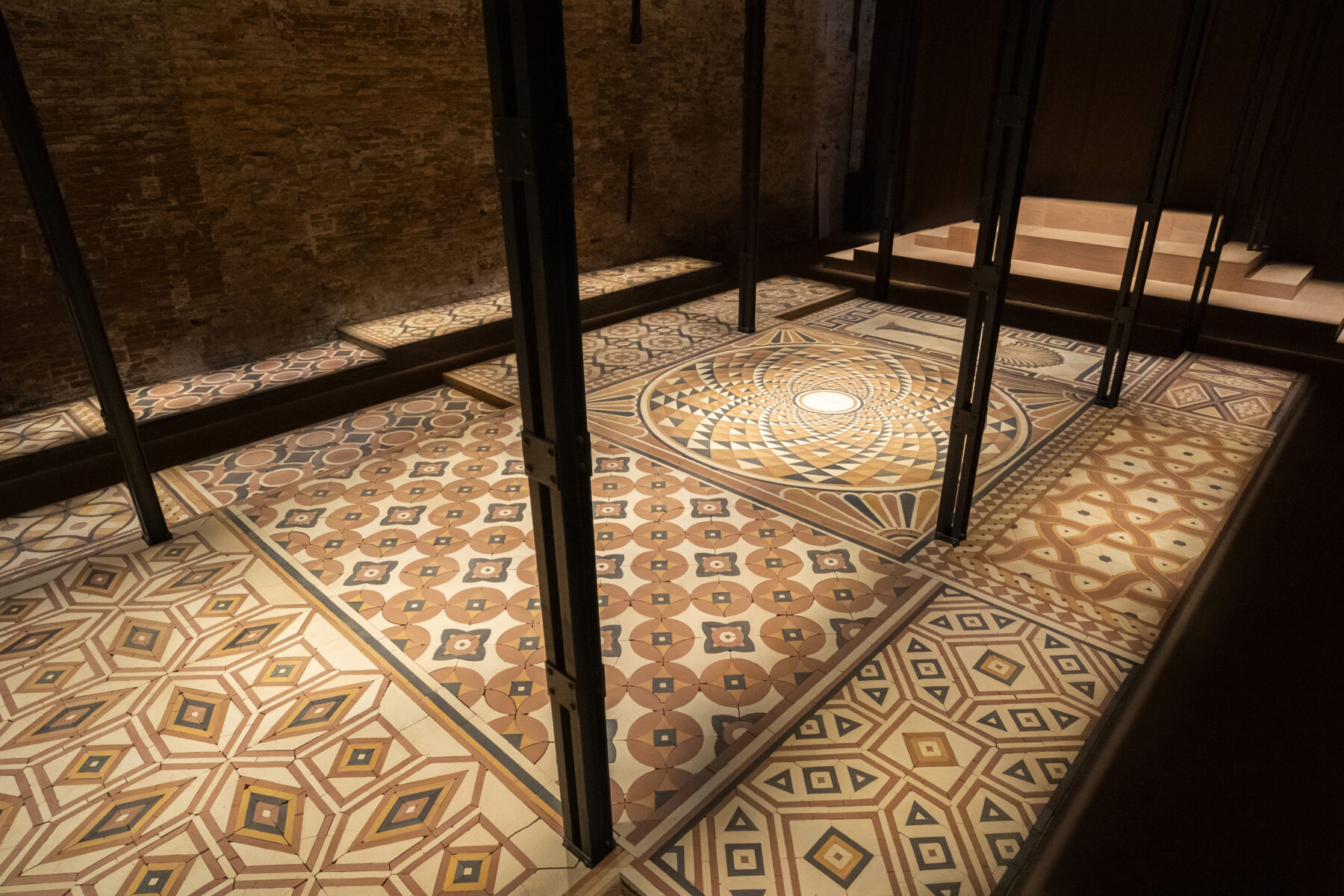
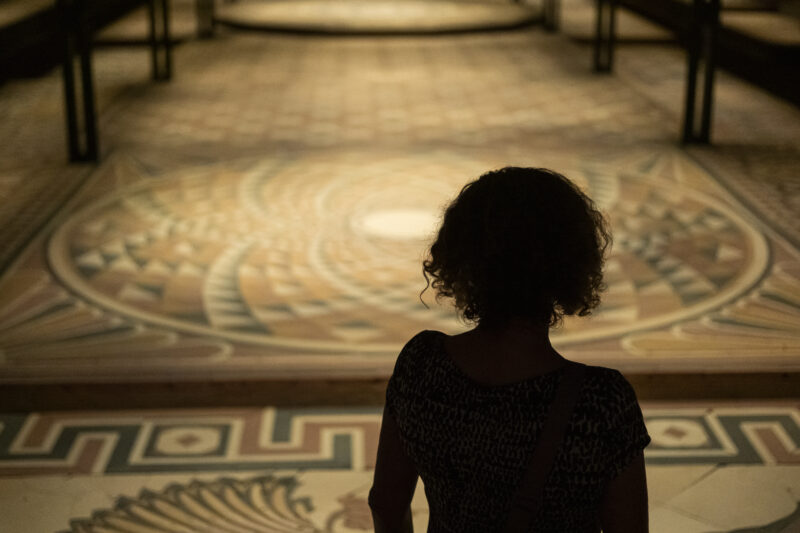
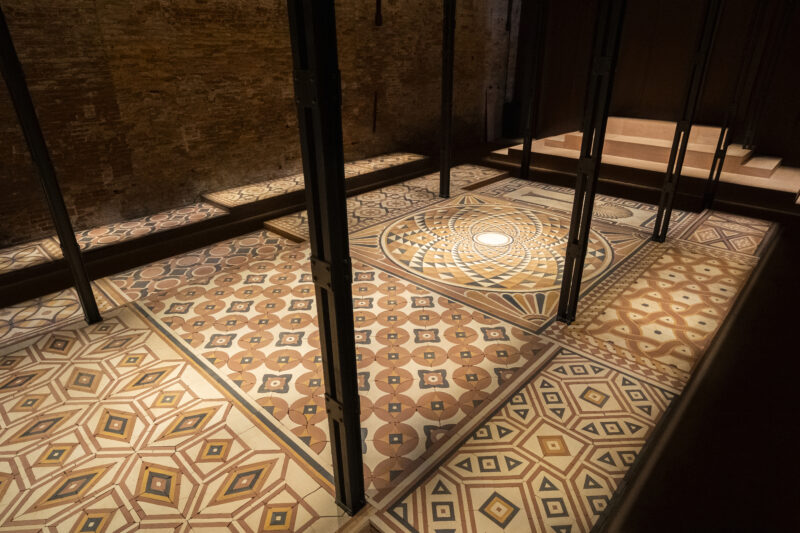
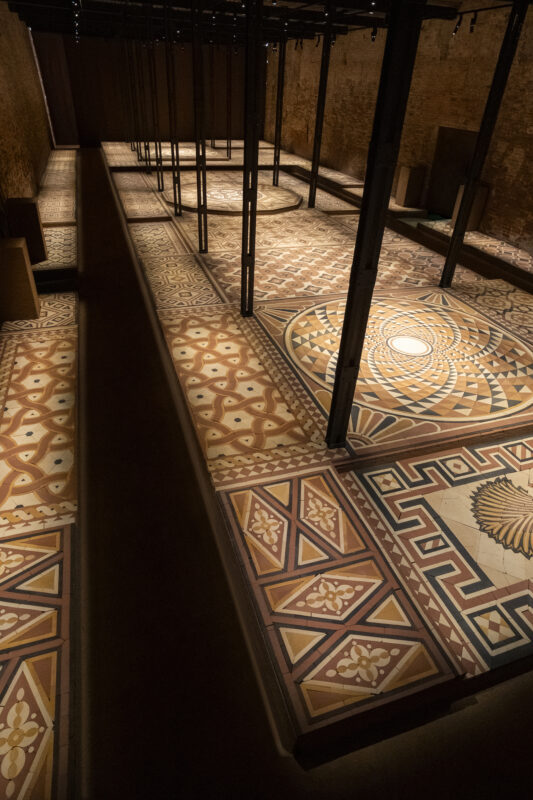
After that work, I researched individual places and focused on the nuances within destruction. From that body of research, I made When the Dusts of Conflict Settle, my stone carving work, because I realized that wars and conflict not only destroy heritage, but also forcibly displace the people who are the guardians of craft traditions. That body of work was looking specifically at the Syrian craftsmen who were forcibly displaced to Jordan, some of whom live in refugee camps. Those are the people I then engaged to make the stones.
MM—Tell me more about that process. You’ve been quite deliberate when it comes to who you engage for different projects and how you work with craft communities. What does it mean to reengage certain crafts in a changing world?
DA—Each time it’s very different. Unlike working with a production studio, where you say, “here’s the design, make it,” when you work with craft communities, you’re working with people who have their own ideas around ways of working. Of course, you’re also working with the human hand and need to understand the medium well. For example, certain stones are too hard to carve certain designs into, which I have an understanding of from my training at the Prince’s School.
I also had to reteach quality control in a way. Craft has definitely been impacted by changing economies and values. For example, in Marrakesh you’ll see certain crafts done poorly and very quickly to sell to tourists at a lower cost. Unlike how traditionally, craftsmen were respected and supported by patronage.
Another thing that I’ve learned from the craftsmen is that these skills are usually intergenerational: you learn from your parents, who learned from their grandparents. You can’t learn it from a book. You can’t learn it in an online course. Unfortunately, a lot of their children don’t want to do it anymore because there is no income for it. They would rather be an electrician, a plumber, or any other job than a craftsperson, and that, for me, is super sad.
That’s why if I’m getting a production grant to produce something, I ask myself, “How can I use that money so it doesn’t go to a big corporate company or factory? Let me work directly with communities and people.”
It takes a while to find the right people to build long-term relationships with, but I always try to work with them again. For example, I’ve done five projects with the same Syrian stone masons now. I have one guy I work with for my darning work in Mumbai: he’s 80 years old, had moved back to India, and was working as a security guard, so I hired him full-time to work with me. It’s a fine line, you have to build relationships and then sustain those relationships and try to find ways to work with them continuously instead of being like: “let’s do one thing, and that’s it.”
MM—I’m reflecting on some of the different materials you’ve used, like sand, mud brick, stone, and fabric. On one hand, you’re using these materials to speak to cultural destruction in many forms. On the other hand, these materials themselves are not stable. Maintenance used to be its own art form, you could say, and in your work with darning that aspect is actively engaged. How do you think about the tension between preservation and impermanence?
DA—The art of repair is a craft in itself, and it’s a global craft. In the West, it’s called darning. In the Arab world, it’s called reta. In South Asia, it’s called rafu. It’s also about the relationship we historically had with our garments and things, where when something was damaged, you repaired it. You kept it for a lifetime, and you didn’t just throw it away like we do now.
We live in such a capitalistic society where you can just throw things away, go to Zara or Primark, or buy something else for $3 and there are so many problems with that, just on the sustainability and environmental level. I believe that when you look back at traditional crafts, such as darning, you can find solutions to problems we’re now facing.
Darning can also be a meditative process. It speaks to a sense of helplessness I sometimes have when I’m sitting behind a screen and witnessing this mass cultural cleansing of your identity happening. I can’t do anything besides this repair. If I think of just recreating an object that’s meant to be destroyed, it’s a form of resistance, right? There’s a reason the IOF is trying to erase the history of Palestine. There’s a reason Daesh are erasing these buildings. Because it doesn’t fit into a narrative that they want to establish. So when I’m recreating it, it’s a way of saying: it exists whether you like it or not. I feel like it’s the only sort of power that I have to make a difference.
I think you see this sensibility in traditional craft because of its meditative and spiritual aspect. There’s one group of craftsmen I worked with in Rabat in Morocco. They are potters that just make hundreds and hundreds of tajine pots every day. They don’t look at themselves as a workshop. They are a zawiya, which is an Islamic institution connected to Sufism. Their form of worship is sitting at the wheels, spinning the same pot over and over again. It has a very grounding quality to it, not just because of the meditative aspect, but also the materiality. You’re just constantly holding onto natural material, right? Whether it’s pottery where you’re touching soil, or textiles where you’re working with natural cotton and silk, or wood that comes from nature, all of it is ultimately rooted in the earth. I really believe that craft traditions have healing properties. Craft teaches you how to slow down and to remember how to coexist in harmony with nature, which is something we have lost in modern day society.
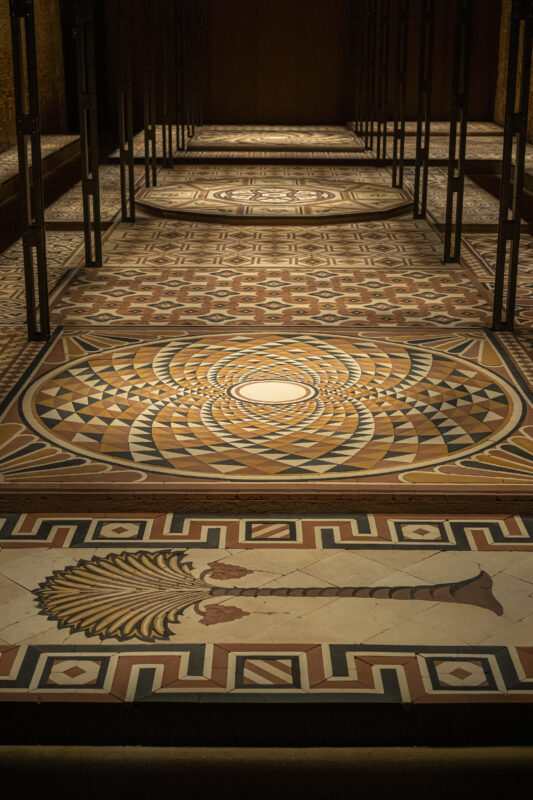
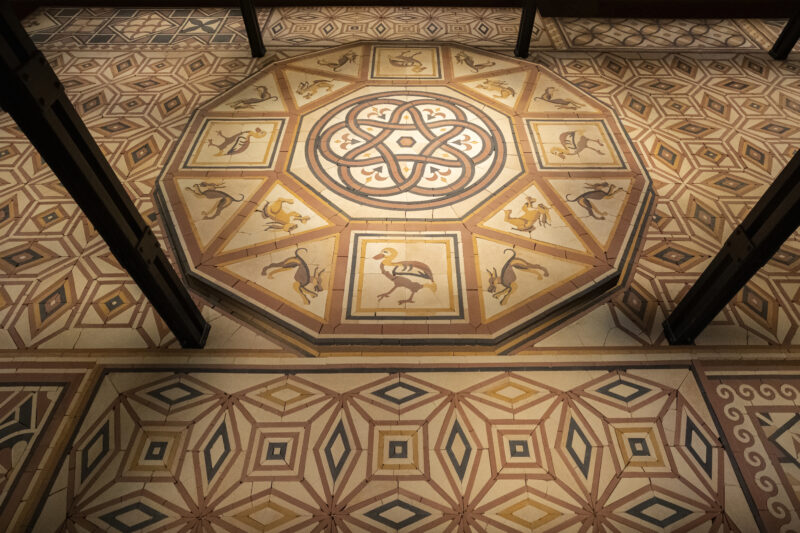
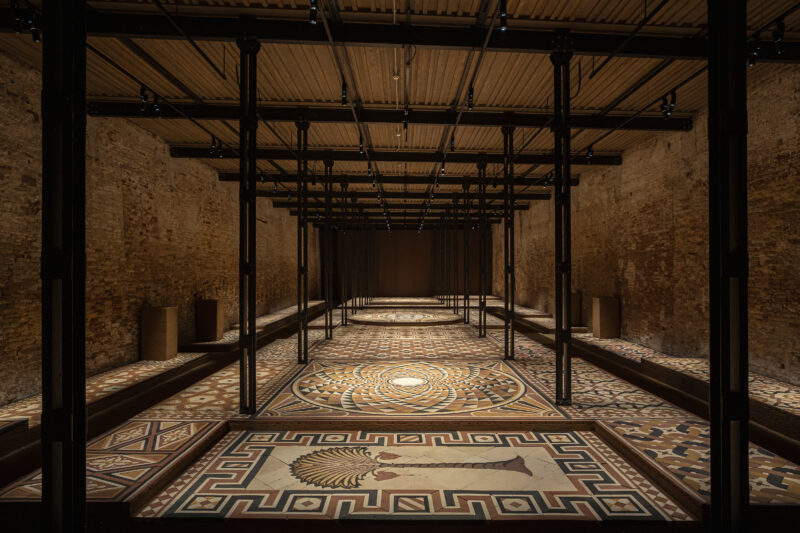
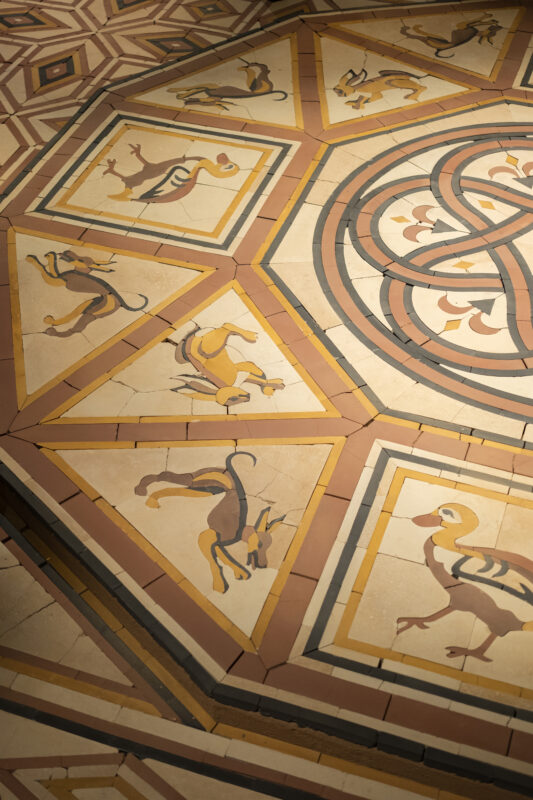
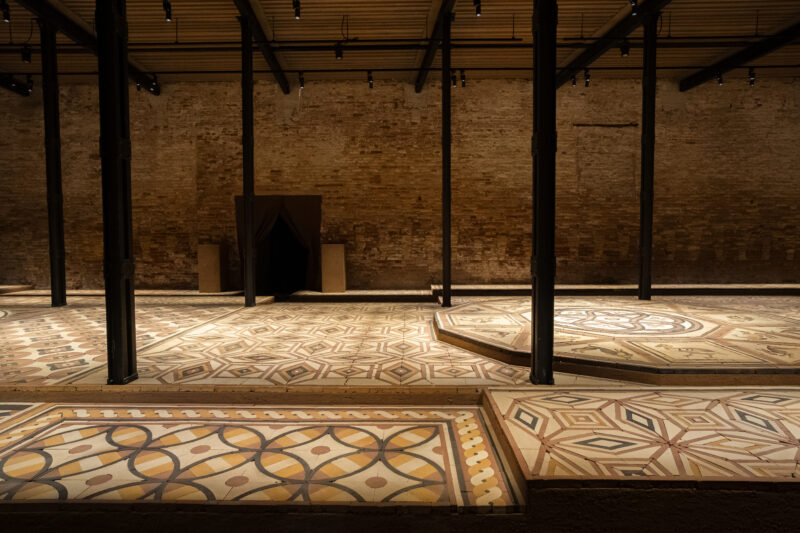
Photo Alvise Busetto.
Courtesy the artist and Visual Arts Commission, Ministry of Culture of Saudi Arabia
Photo Alvise Busetto.
Courtesy the artist and Visual Arts Commission, Ministry of Culture of Saudi Arabia
Photo Alvise Busetto.
Courtesy the artist and Visual Arts Commission, Ministry of Culture of Saudi Arabia
Photo Alvise Busetto.
Courtesy the artist and Visual Arts Commission, Ministry of Culture of Saudi Arabia
Photo Alvise Busetto.
Courtesy the artist and Visual Arts Commission, Ministry of Culture of Saudi Arabia
Photo Alvise Busetto.
Courtesy the artist and Visual Arts Commission, Ministry of Culture of Saudi Arabia
Photo Alvise Busetto.
Courtesy the artist and Visual Arts Commission, Ministry of Culture of Saudi Arabia