Courtesy of Genavie Williams.
We’re all filled with profound ideas. We’re also equally, if not more, filled with imitative ideas. I am constantly coming up with, refining, and exploring ideas in my classroom as well as in my own artistic practice. So, how do artists get their ideas? Some concepts are informed by experience and are built naturally. Others are engineered. Perhaps some come spontaneously and effortlessly, feeling heaven-sent. Consider ideation as an intentional process that can be taught and practiced.
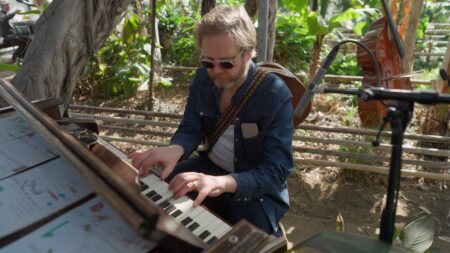
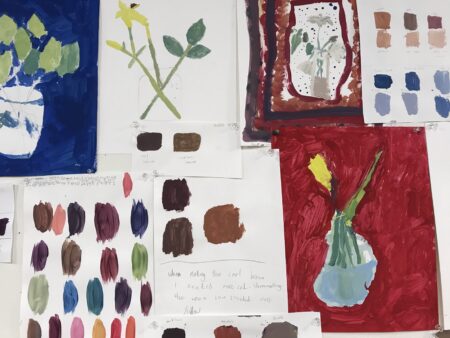
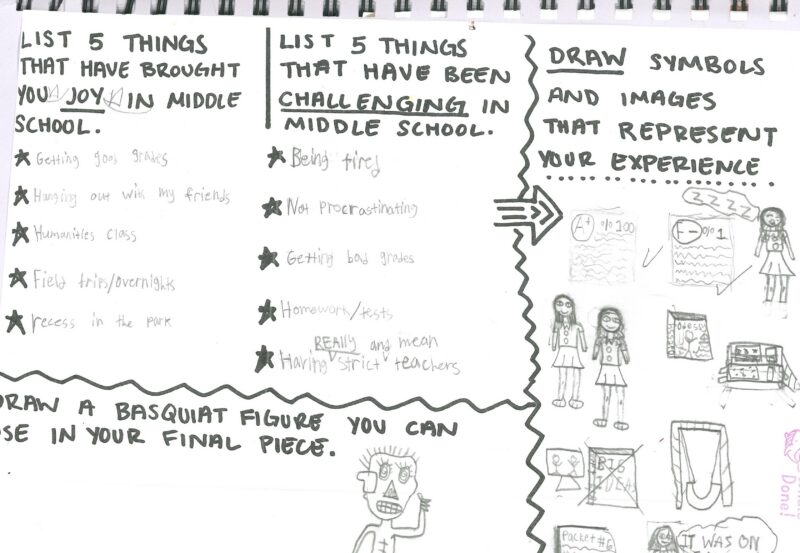
The inevitable “I can’t think of anything” occurs frequently in the classroom and the studio. A list of remedies I’ve used to spark inspiration are: collecting, playing, noticing, referencing, responding, reflecting, questioning, and observing. In the Art21 film “Ilana Harris-Babou’s Guide to Health and Happiness,” observation and play translate into Harris-Babou’s work about aspirational industries. Harris-Babou observes commercials, tutorials, and advertisements with a close eye, examining them for their nuances. She makes videos with her mother in a playful manner, which she says are often unrehearsed, to create her art. Finding ways to look closer and interact with what is around is a great way to begin forming an idea. Other more hands-on methods for ideation include open exploration of materials, testing pliability, and making lists. Artist Jack Whitten is quoted as saying, “I like to think of my studio as a laboratory where experiments are conducted.” Allowing time to explore what a material can do allows the artist to see where boundaries lie and where opportunities for adding, subtracting, and altering can occur.
Courtesy of Genavie Williams.
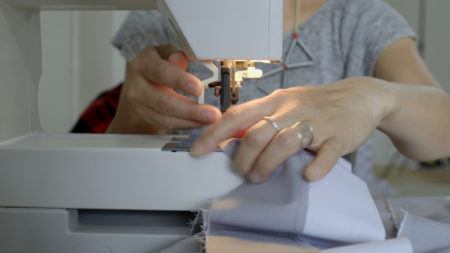
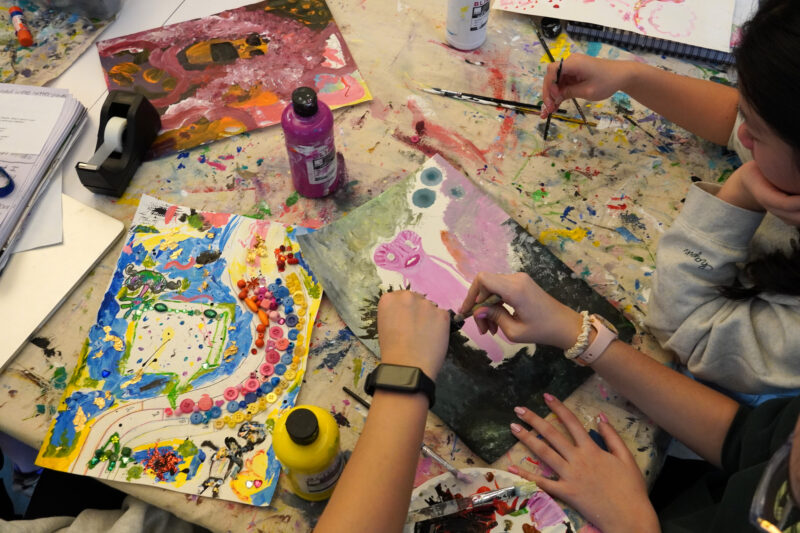
Artists create space for their ideas to run their course. Creating space for an idea is about meeting conditions. Conditions can be physical and intellectual. Physically creating space for an idea can be about a clean, organized space, accessible materials, and uninterrupted time. Mentally creating space for an idea can be about learning a technique, time for drafting, or prompting questions to stretch the idea. Once conditions are met the idea is alive. Naturally, not all ideas will see fruition. When an idea isn’t working how we imagine, sometimes we feel stuck. Changing, pivoting, adding on, taking away, or even letting go of an idea are all acts of nurturing. Artist Amy Sillman embodies this practice. In her film “To Abstract,” she speaks to the resistance of her materials and how there is a constant need to reinvent in her process. Miraculously, these changes can act as bits of information that contribute to new ideas.
Courtesy of Genavie Williams.
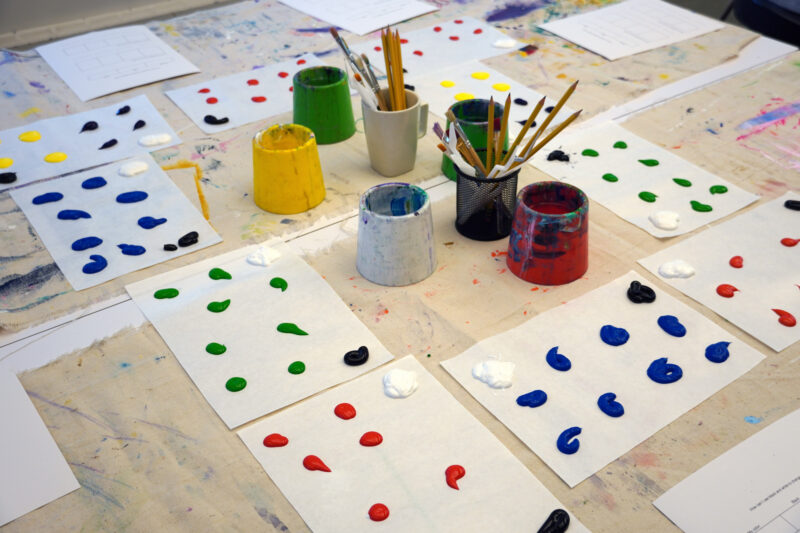
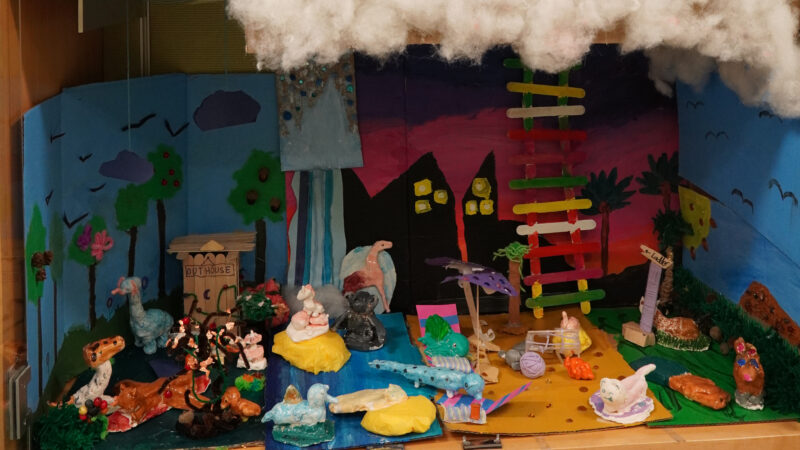
Circling back to the question, how do artists get their ideas? Part of the answer may be: not all alone. Ideas are best when they are formed and nurtured with others. In Rick Rubin’s book The Creative Act: A Way of Being, he writes, “Cooperation supports the highest outcome.” When people think together, a wealth of knowledge is created. We see this concept supported historically in the form of artistic movements and collectives. The quintessence of this idea is my fourth grade visual arts class. My students spend an entire semester honing skills, leading them to collaborate on a piece of installation art.
Courtesy of Genavie Williams.
After turning imagined animals into ceramic sculptures, students are posed with the question: Where is a place all of our animals can live together? The answers are beautifully imagined: in a cluster of islands, candy land, or in outer space. What makes collaboration a strong form of ideation is the resistance it comes with. To create their piece of installation art students need to share, build upon, and communicate their ideas to one another. To nurture their ideas I help them compile and organize thoughts and then propose logistical questions. They make choices as a consensus, considering the needs and feelings of others. A pushing and pulling of ideas that help the strongest ones to shine through. Together they create a piece of art that is strong in scale and design due to their collaboration.
Ultimately, ideas are more than a ‘Eureka!’ moment. They can be intentionally formed through experimentation, nurturing, and collaboration. To talk about contemporary art is to talk about concepts, and today’s artists exemplify a variety of ideative methods. As artists and educators, we have the opportunity to see ideas take shape and sometimes transform entirely. By modeling and fostering intentional ideation, we empower ourselves and others to create beyond what we think of as possible. And as my fourth-grade class reminds me, the most powerful ideas emerge not in isolation but in community, where imagination is stretched, challenged, and enriched.
Genavie Williams is an artist-educator dedicated to the belief that art is a tool for connection. Throughout her career, she has shaped visual arts programs in San Francisco and New York City. Her teaching philosophy is rooted in contemporary practice, encouraging students to view their world through the lenses of observation and questioning.
Williams’ own artistic practice, CreativeDepartmentArt, focuses on place, attention, and presence. By engaging with these themes—on exhibition at Cafe Galerie in downtown Manhattan—she models a life of active exploration for her students. Her work is a testament to the idea that the classroom and the studio are interconnected places for expression.