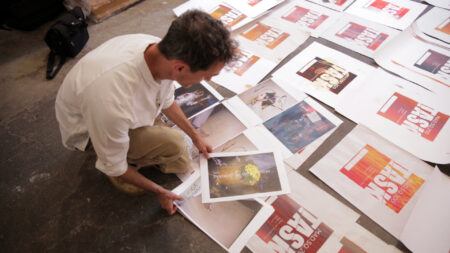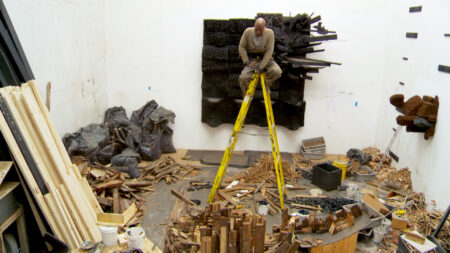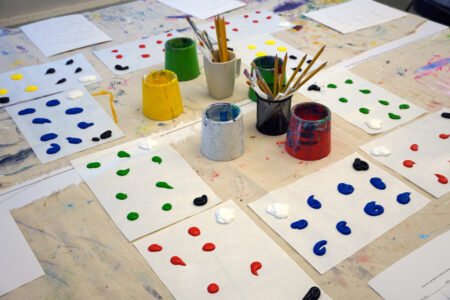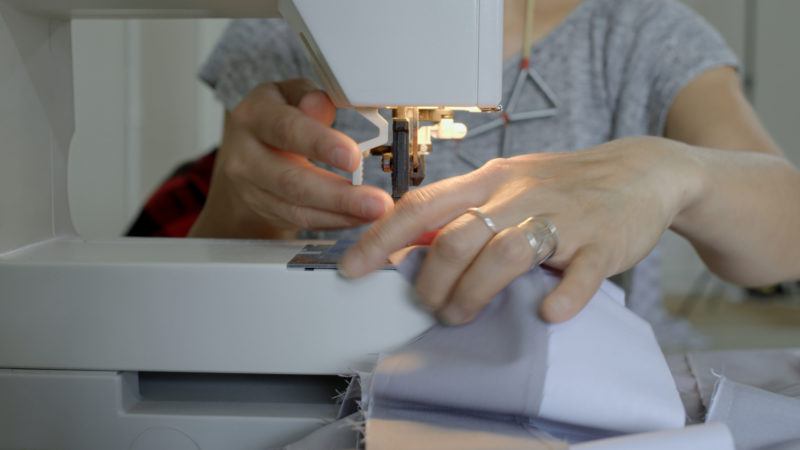
Production still from Art in the Twenty-First Century Season 9 episode “San Francisco Bay Area.” © Art21, Inc. 2018.
Despite its continued and growing cultural relevance, the historical precedent of craft as women’s work and labor for the disenfranchised has relegated craft to a second-tier status. Craft has been mischaracterized as solely physical work with a lack of cerebral interpretation and not as important as traditional fine arts practices such as painting and sculpture. Glenn Adamson, curator and craft scholar, expands on this tension, stating,
“You can make a strong case that the long-standing marginalization of the crafts—and the self-evidently crazy idea that painting isn’t one—was just the art world’s way of practicing sexism and racism, barely disguised as a policing of disciplines rather than people. At long last, then, we have arrived at a reckoning. Art needs craft, and badly.”
Craft has the potential to create greater diversity in the art world, as it represents the work of everyday people, the objects in our daily lives, and carries the history of marginalized communities. With this history in mind, I’d like to consider craft as a pedagogy. Craft challenges the false dichotomy of the intellectual versus the laborer; it disrupts the isolated-genius-artist archetype by valuing communal knowledge building that is embodied through social, physical, and economic communities of shared labor and resources. A craftsperson needs to possess a broad knowledge of intellectually rigorous subjects, such as spatial design and physics, while also having a strong command of their fine motor skills. These attributes can be trained and refined by an educator, as they are not a set of sensibilities or an inherent disposition. Disengaging from a talent or gifted criteria permits craft to be an accessible creative practice that, at its core, relies on time; time to form intimate relationships with people, history, and the material of craft and its context.
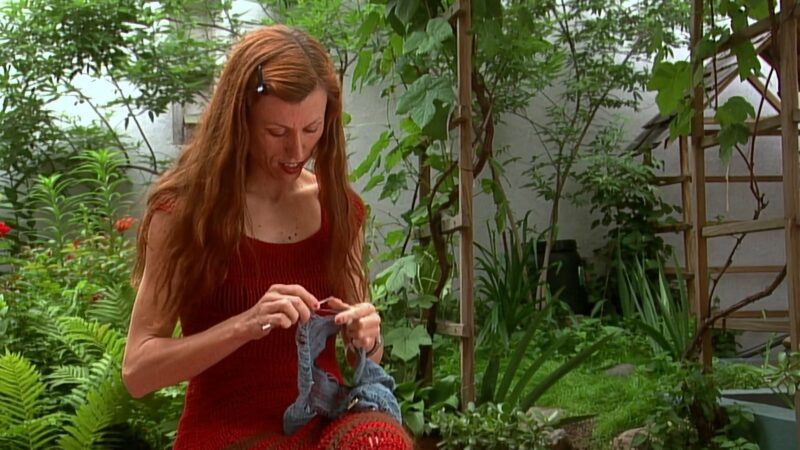
Production still from the Art in the Twenty-First Century Season 1 episode Consumption, 2001. © Art21, Inc. 2001.
Craft time makes space for slowness with objects, which is the opposite of what our highly consumerist culture encourages. To slow down with craft and have a knowledge of materiality and process allows us to make better value judgments in our everyday lives. Picture this: two pairs of jeans side by side that look nearly identical. The first pair, made by brand A, costs $39.99 and is made with 99% cotton and 1% elastic. The second pair, made by brand B, costs $54.99 and is made with 85% cotton, 11% polyester, and 5% recycled cotton. We generally only have price as an indicator of value, and according to that logic, the higher-priced jeans should be of better value than the lower-priced ones. But what does it mean that one contains polyester and the other does not? What does it mean that one has more elasticity than the other? What does it mean that one pair was woven and dyed in Pakistan, while the other brand exclusively manufactures clothing in China, Bangladesh, and Vietnam? To borrow from Paulo Freire’s Critical Pedagogy of the Oppressed, to know the craft of these objects allows us to make decisions with information that does not solely rely on a banking model of education where we are told what has value and what does not. Craft knowledge provides us with a lens to develop generative inquiry that questions how things are made, who makes them, and where they come from. This ultimately leads us to a study of our relationships to each other and the natural environment.
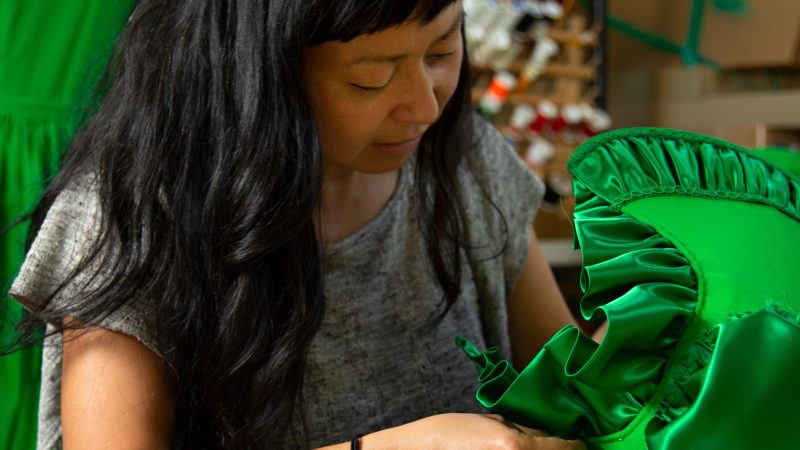
Stephanie Syjuco at work on The Visible Invisible (Civil War), 2018. Chromakey green-screen cotton fabric, silk, polyester, ribbon, lace, and display form. Photo: Jin Zhu.
Contemporary artist Stephanie Syjuco embraces craft knowledge as a form of transgressive consumption. In The Counterfeit Crochet Project (Critique of a Political Economy) (2006–onwards), Syjuco connects fiber artists to create bootleg designer handbags. Syjuco asks makers to crochet a designer bag that they want, but can’t afford. By creating these bootleg bags, Syjuco and the other makers challenge what is deemed precious or valuable within the larger consumer market by placing value on their hand skills, ways of working together, and the power of imitation and reproduction to question what is authentic. Similarly, contemporary artist Andrea Zittel explores questions of authenticity, craft labor, and repetition in Art in the Twenty-First Century Season 1 episode, “Consumption.” Zittel describes the fashion culture at an office job she once had, where she was expected to wear professional and “fabulous” outfits every day and felt the social pressure of needing to wear something new. But Zittel could not afford to buy new clothing so frequently. This realization led to the A-Z Uniform Series (1991-2002), a project where Zittel wears the same handmade garment every day for an entire season. Craft allowed Zittel to break the rules of fashion, as did Syjuco, by creating a new language for art and fashion that centers their real-life experiences, needs, and desires.
Craft is a way of seeing that considers care, skill, technique, material, and process. It demands that we look for the unseen, the people, and the hands behind the work. By tracing the history of material and process, we follow the stories of the working class, women, people of color, and other disempowered groups who were forcibly made unseen. Understanding craft histories can hopefully uplift the labor of these groups, but may also help us see the craft and care all around us and feel implicated in the labor of the objects in our daily lives.
Makda Amdetsyon is an educator, researcher, and maker. She joined Art21 as the Education Coordinator in June 2024. Makda comes to this role with a background in facilitating reflective and inquiry driven museum visits and artmaking classes for K-12 students and teachers at the Brooklyn Museum. In addition to her work as an educator, Makda is experienced in artist engagement and communication. During her time at the Smithsonian Center for Folklife and Cultural Heritage, she interviewed artisans and co-produced public programs for the annual Folklife Festival. Makda’s work as a researcher focuses on craft, bridging her art practice and academic studies on American craft and material culture.
Makda is also a textile artist and sewist. She has spent the past several years honing her craft in weaving, dyeing, and sewing at craft schools across the country. She holds a BA in Communications from University of Maryland, College Park and an MA in Art, Education and Community Practice from New York University.