I am here in Guatemala now and my family is planting and working the land. I say to myself, “I should be there too.” But, in the end, your group, your family, understands the importance of each person being where they are so that one can bring new ideas, proposals, or projects to make and develop. That dynamic happens within my family. I also bring work and projects to them when I’m in another country and I tell my brothers and sisters to help me develop them. When I put forth an idea, they tell me, “Let’s do it this way” or, “We have other ideas, too—we could do it this way or that way.” For example, I want to embroider something in one color but they tell me, “Don’t you think that based on your idea and where it’s coming from, it would be better to use this other color?”
I think that as an artist, as a human being, we need other people. One cannot do everything alone. For instance, when people are cooking in my house, everyone wants to share the food, right? Because people prepared it with a lot of effort. Figuring out what to prepare and making sure that all the ingredients are good involves many people. Everything came from different places, someone had to sow the seeds, someone cooked, and we all shared. For me, that’s a way to view collaborations in art. Nothing can be done alone.
Sometimes, when I’ve thought that I want to put on an exhibition, more and more people come together until it becomes something much larger than my desire, and in the end, you realize that each person does their part. It’s like sharing authorship with everyone. But, you also have to carry and put things back in their place. Sometimes in that process, there are fewer people, but someone has to take responsibility and return everything back where it was. In that sense, I feel that collaboration is something I have learned from my family.
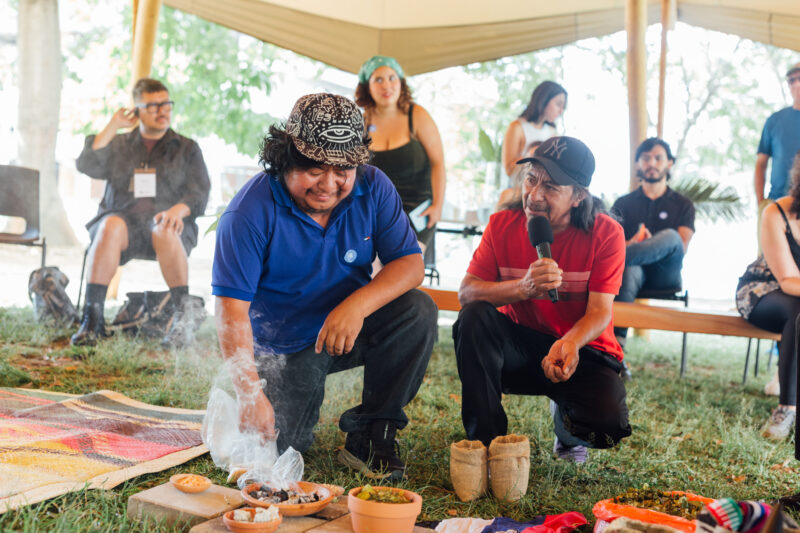
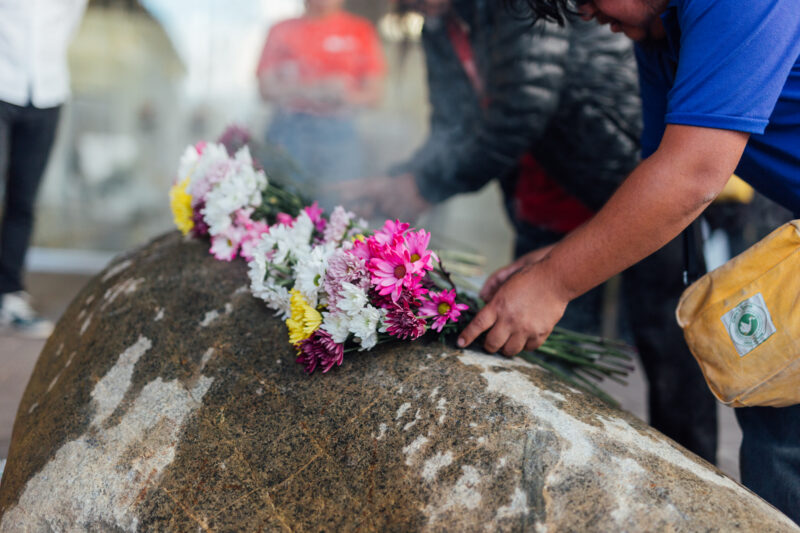
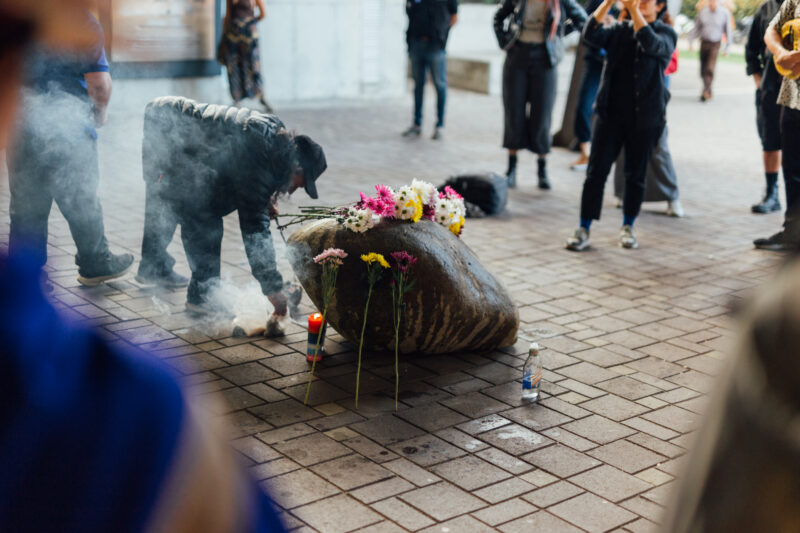
I think that is also related to Maya processes and ceremonies: the offerings. When you make a fire, there’s someone who invokes all of the energies that exist within the cosmovision and each person brings their own offering to give. That’s very interesting because when you make an offering within an institution, the institution just buys everything. Sometimes, people don’t bring anything at all [laughs]. But, when everyone brings something, everyone has something to say, to share or contribute. I’d like exhibitions to be more like these processes and ceremonies, so that people feel they can share what they think or what an artwork generates.
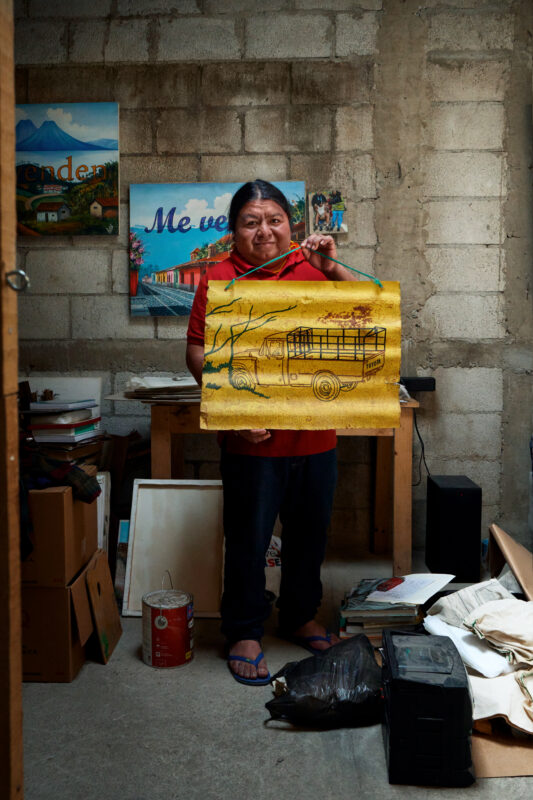
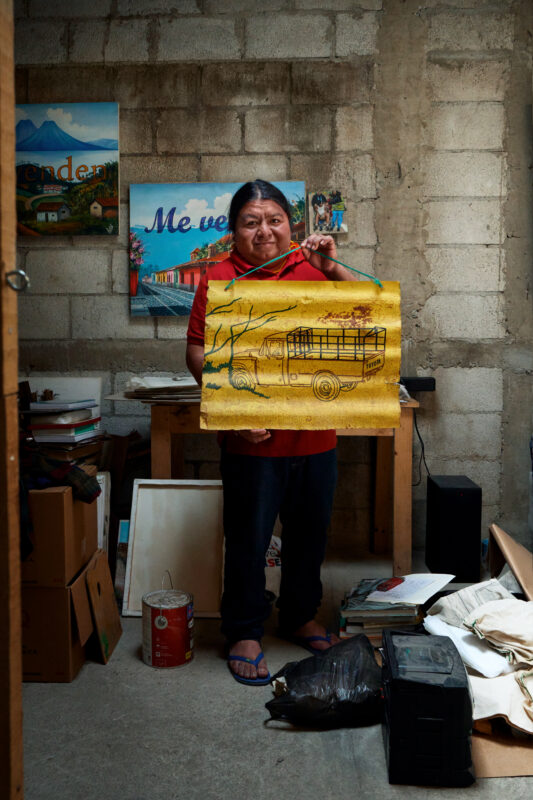
In collaboration, there’s the freedom to create without being limited to one single idea—one can transform an idea and allow it to become lost and be transformed. I think that this happens in Comalapa, where I live. There are many people who make art, there are many artists, there are many people who are dedicated to poetry, cinema, theater, and dance. In a town with so many people, each family has an artist.
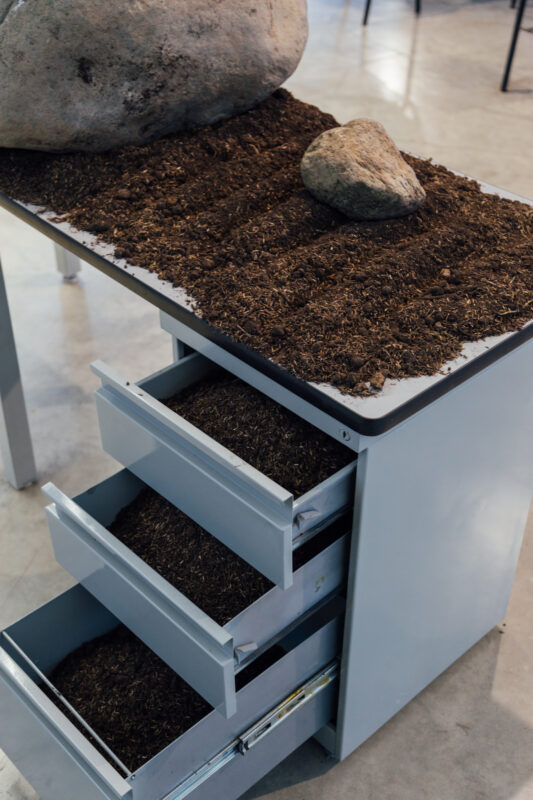
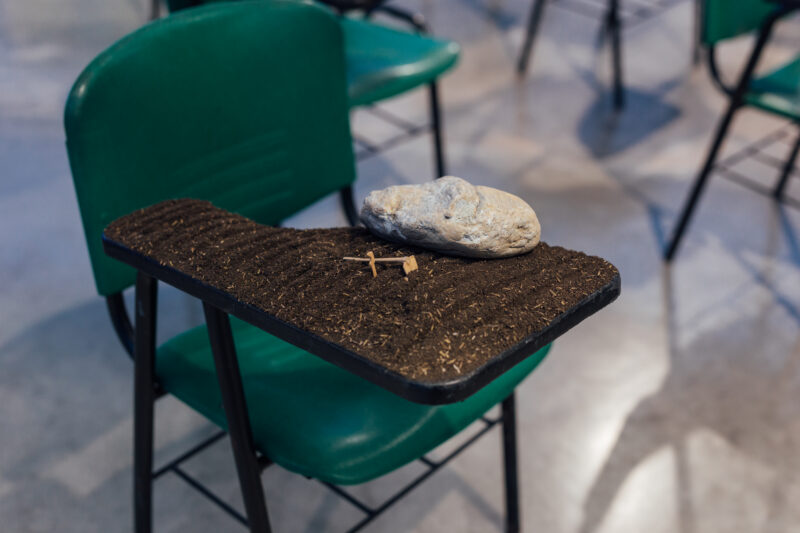
I had been invited to do an exhibition in Colombia at the Museum of Modern Art in Medellín. I proposed building a school of sorts. On top of the children’s desks, there would only be soil, rocks, and a small garden hoe, these elements that we are familiar with, but also don’t know. In the background, I had made some embroidered works. I was speaking with the curators and I told them that I’d also like it if we could cultivate land outside of the museum so that some artworks don’t enter the museum, instead they’re worked on by people that aren’t considered artists or look to become artists.
I spoke with the museum staff and told them I would like to invite my father to be able to develop two projects for the exhibition, one within the museum and the other outside of it. It was so amazing that in both projects, many people came together to collaborate and work together. There were people that were excited to work the land; it was more interesting to them than working in the museum. When we were working outside the museum planting, people would tell us, “We come from the countryside, we’ve always done this work, we like it, and it’s the work we miss when we’re in the city.” Different artwork allows you to generate a dialogue with people. And that’s why I say, there are many works that are interesting and don’t need a long text for people to understand them, to collaborate and participate in them. That’s the magic of projects that develop because of a museum, but do not enter the museum itself.
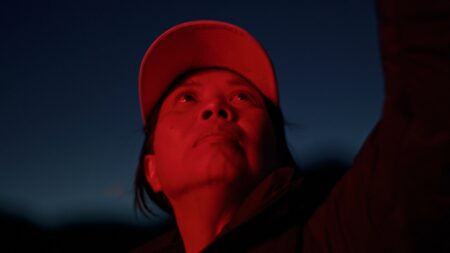
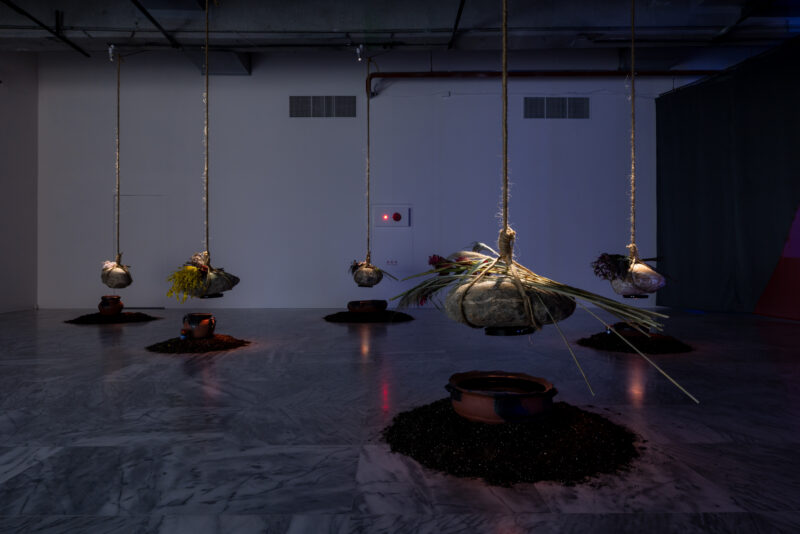
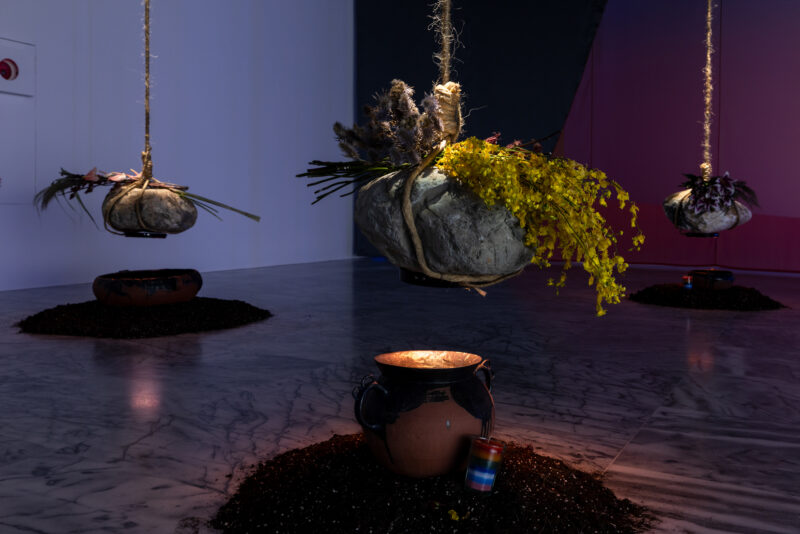
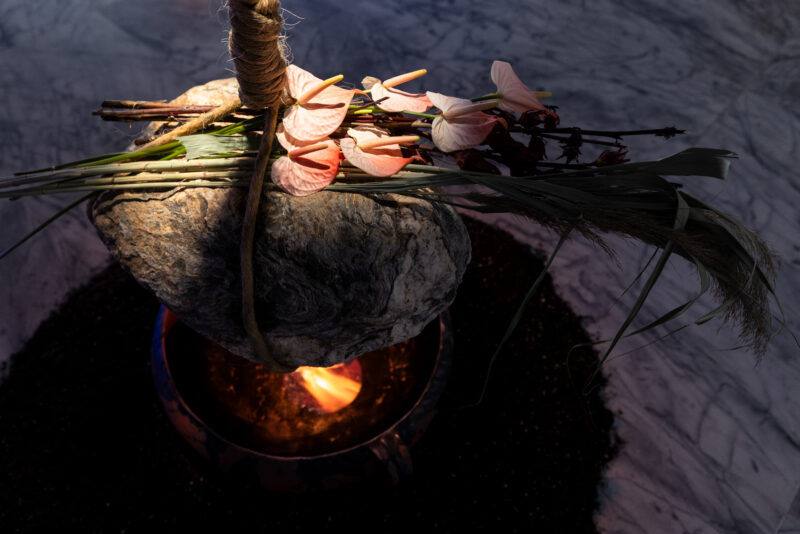
I did an exhibition in Taiwan and the idea was to bring fire into a museum, but it wasn’t possible. The original concept was to put fire below a stone that is suspended. At first, I had been told it could be done, but in the end, I was told it couldn’t. So, I kept thinking and said, “Well, this idea can be transformed.” So, beneath the suspended stone, I placed a pot of water and installed screens where a flame could be projected and you could see the reflection in the water of the pot. It was another way of transporting the fire we made in Comalapa. In the end, we were able to share this fire, perhaps not in its essence, but through art and technology we were able to translate some ideas that could connect directly with some of the ways of living in Guatemala.
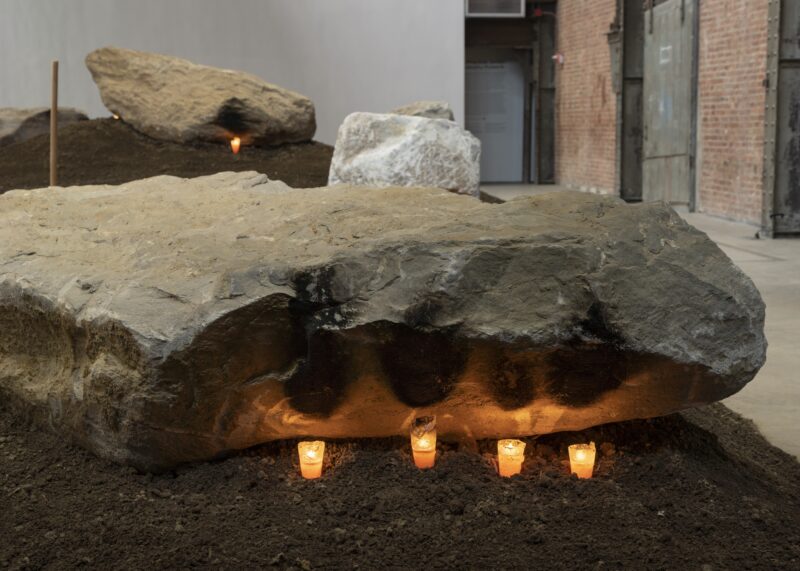
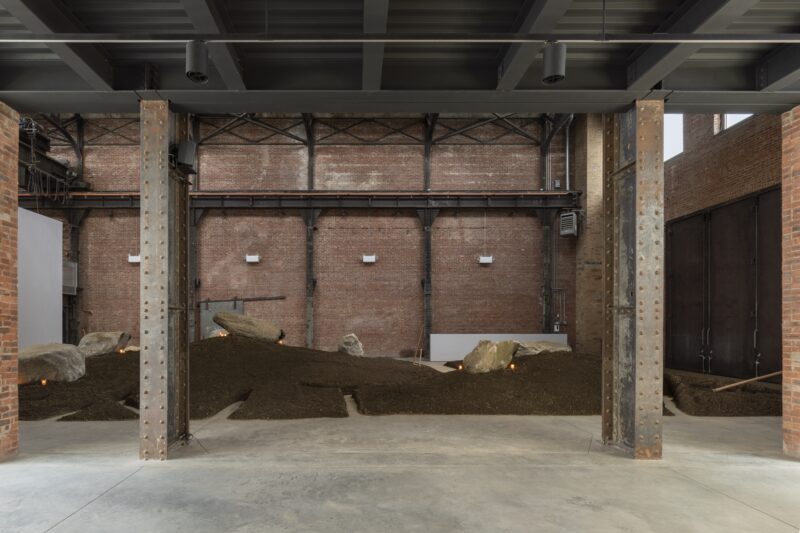
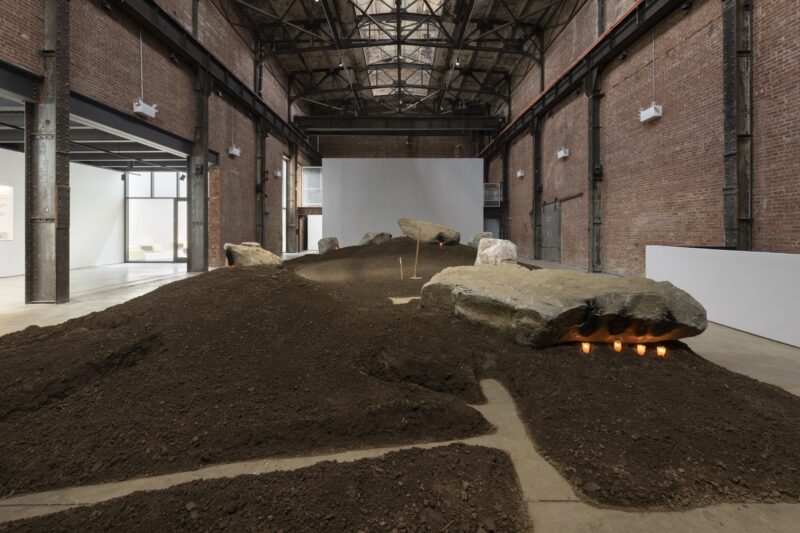
In Taiwan, they originally asked me, “Why fire?” Fire is so that people can warm their hands [laughs]. It seems simple. Perhaps it’s the same idea as the offerings of stone and fruits, or the work we showed in SculptureCenter, B’alab’äj (Jaguar Stone) (2023), a piece where people helped us make mountains of soil, people that came from Guatemala, Mexico, and Venezuela. They would ask, “And what is this for?” That’s where the work begins, not by telling the stories of where it comes from but instead what it does. Why bring soil into a cultural space? In the end, we’ve all been moved by the very earth itself. In Guatemala, many people have left because they need a piece of land, or sometimes land is sold so someone can go elsewhere. There are many stories connected to just one element. Earth and water are elements that people kill and fight over, it forces you to emigrate or stay put. Those are the ideas and experiences that have nourished me to think of the next ideas and projects that are coming up.
There’s also a line of my work that comes from dreams, and that’s very beautiful. Dreams are among the most beautiful things because you bring something from the world of sleep into reality. Suddenly, you see how a dream unfolds in a museum or gallery. Then, when you return to your dreams, it feels like a journey through time. Sharing a dream is special because it’s sharing interpretations or experiences. Sometimes there’s a thread between dreams, and all that’s missing is listening to someone else’s dream, letting the dreams complement each other.
A few years ago I was talking with Paulo Nazareth, a friend from Brazil, and I told him I wanted to go back to Brazil. He said, “Ah, look, I have a notebook where I’m dreaming that you’ll come.” So he put together a project and invited me to go. Sometimes, that’s just how things happen, right? On that trip, I stayed in Brazil for a long time and my grandmother passed away while I was there, and it became a transformative trip. I wanted to do something elsewhere, but I stopped seeing things, like my family and my community. Then you ask yourself, “What is art for? Is it to go see the other side, or is it to stay here and see what’s happening?”
While I was in the process of that questioning, I came to understand many things about how to preserve a person’s memory while being far away. I took many notes. I created an anthology of memories of my grandmother and of the people who are still alive. I feel I have to keep that memory, since it’s all that remains of people, you know? Just remembering the tone, the timbre of their voice, and realizing I’ll never hear it again. That’s what I was translating in my notes. It’s a very beautiful search, but you don’t know where to start; you just arrive.
There are many paths in the creative process. There isn’t just one. There’s a desire to preserve the memory of my family, my town, or my community. Some works are born from the pure desire to experiment because I enjoy the medium. The desire to make art comes from many different paths, which is why I make such different kinds of work. Many pieces emerge very spontaneously: I see moments and think, “That’s really interesting, I should photograph it.” That photograph becomes a memory of something I’ll never see again. It’s about having the sensitivity to recognize that something interesting is happening. Sometimes, artworks become more powerful over time because we come to understand it better with time rather than as they’re happening. There isn’t a predetermined path of where an idea comes from–it’s just a gift from life.