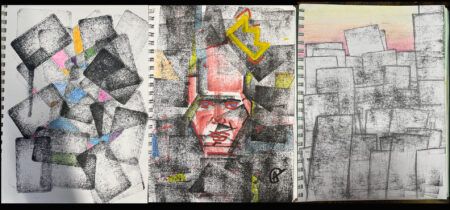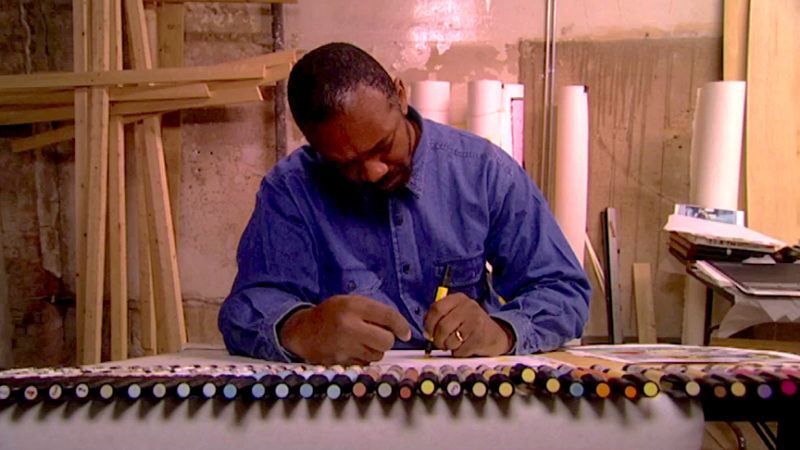
Kerry James Marshall at work on his comic book series “Rhythm Mastr.” Production still from the Art in the Twenty-First Century Season 1 episode “Identity.” © Art21, Inc. 2001.
“What is the difference between art as a hobby & ‘living an artful life’?” was a question I posed recently to a class of students in one of the high school art classes I teach on the Upper West Side in Manhattan. The responses were varied but mostly centered around the ways in which students (and adults) are often discouraged from considering art as work, nor as a focus in college or life, etc. Often considered an extra, a good hobby or pastime, how are we then supposed to help ground students in the fact that art is research, art is exploration, art is critical thinking, art is public speaking, art is writing, and, most significantly, art is an academic subject. There are so many artists who have been or are currently educators. I was struck early in my career by the words and wisdom of Kerry James Marshall as he wandered the halls of the museum at the School of the Art Institute of Chicago. In this Season 1 episode, it was exciting (and affirming) to get a glimpse into his journey and work with students as well. Marshall is able to share his artistic journey through art history, technical training, image making, and more directly with his students. The excitement of first-hand experience is palpable and contagious.
This conversation, which comes in many forms, is more about us as teachers and how to balance our rigorous school life with our own creative careers. There are many ways that have helped me get closer to this artist/teacher balance and I will share some of them with you now. The first, working alongside students on my own work or even in a sketchbook during work sessions, was encouraged by my current department head and has been an important bridge between the two worlds. It is also important to note that many of the greatest lessons I have folded into my artistic practice have been gleaned from my work with students. For instance, I realized early in my teaching years that I tended to be a bit more open to learning from a larger range of artists, practices, and even media when attending museums, galleries, viewing books, or making my way through the many amazing Art21 films.
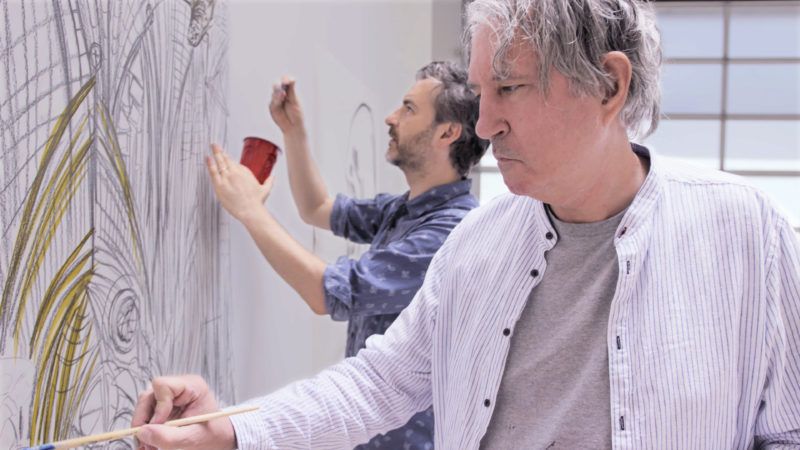
Production still from the Extended Play film “Marcel Dzama: Drawing with Raymond Pettibon” © Art21, Inc. 2019.
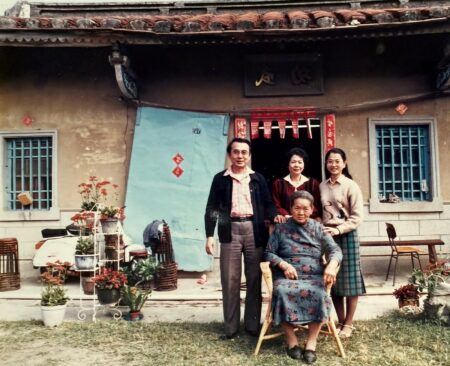
I have learned to lean into collaboration both in classes and in my role as practicing visual artist. This has expanded my working methods, helped me grow as an artist, and helped encourage this idea of community in purposeful ways during work on in-class projects. I learned that artists do not have to “isolate” to create, as demonstrated most beautifully by Marcel Dzama and Raymond Pettibon, and that many of the “geniuses” of yesteryear were deeply connected to other artists and this community led to many of their greatest accomplishments. My students and I were struck by the playful and powerful collaborations between Christine Sun Kim and her family in both the recent Art21 film and in her exhibit at the Whitney Museum here in New York. Whether initiating this wonderfully rich artistic sharing through napkin drawing like Pettibon and Dzama or interpreting the same prompts as seen with Kim and her family, it helps us build connection and see our own personal practice with fresh eyes.
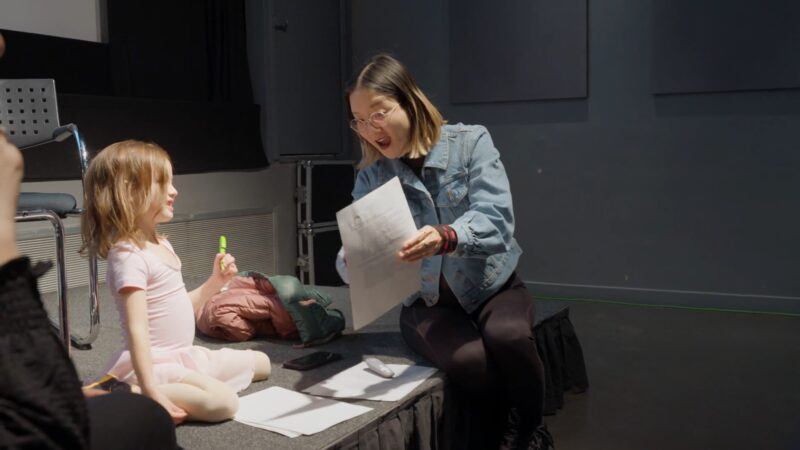
Production still from the Art in the Twenty-First Century Season 11 episode “Friends & Strangers.” © Art21, 2023.
Consider joining a nearby existing community or even starting your own. Getting together and sketching can be a great way to connect, share, and hold each other accountable. It can also be a great way to creatively play and have fun! You can also build your own community, perhaps a brunch critique group or a museum meet-up? I have enjoyed groups where we simply show up and sketch each other as well, or collage and write poetry. It may be something that begins with just a couple of people but grows as time goes on.
Less romantic but vitally important has been to set a working schedule and be creative in finding ways to weave art into your daily life. Perhaps it means listening to an art podcast or watching an art video while working out or carrying a smaller, pocket-sized sketchbook everywhere you go so it is readily available when you find a moment or two. It can also mean setting aside time in your day that is dedicated to art making. Set goals for yourself that are attainable, perhaps applying to one show a semester or applying to an artist residency during one of your breaks. It may be simply to create one piece a year or attend a workshop at a local museum or art center.
Lastly, be sure to show yourself grace, patience, and kindness. One of my teachers once told me that sitting and spending time looking at your work and the work of others should take up about 90% of your practice. I was shocked at the time but realized soon after that the guilt of “not making” all the time could be debilitating. In contrast, the meditative moments of really looking and studying my own work or that of others provided so many revelations that were fuel for much of my future momentum.
We are very much like our students: we have an unlimited supply of exciting questions and we, like them, are artists who feed voraciously off of those questions. We can do anything! As artists and educators we are so much better at both when a balance is struck. Don’t forget that art is an academic subject, be a critical thinker, lean into discomfort, take risks in your work, set a creative schedule, be a great student of the arts, and take time to connect, listen, look, reflect, and repeat.
Gregg Emery is an artist, art educator and creative leader with nearly 30 years of experience in K-12 art education. I have always focused on both artmaking and teaching and how the two can feed one another for the benefit of the students and larger community. My focus in both fields has always been that of a life-long learner whose focus on collaboration and connection has led to innovation in meaningful and purposeful ways. Currently, I teach visual art to grades 7-12 at the Trinity School in New York City.
Recent exhibits of my drawing, paintings and collaborations include a solo show in Brooklyn, a group show with Young Soy gallery of Hong Kong as well as shows in New York, Amsterdam, Chicago and Miami for Art Basel. My work is a part of private and public collections around the world including the permanent collection of White & Case, Aston Martin, American Copper Building, Jack Daniels and the Baltimore Museum of Art. I also serve on the Board of Directors for the Poetry Society of New York and have been an Art21 Educator for the past 3 years.