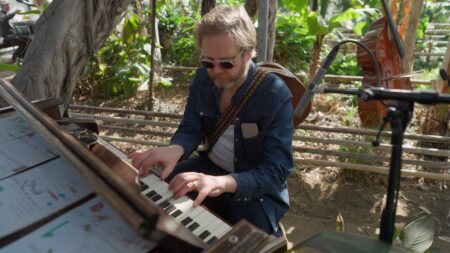
Tomás Saraceno
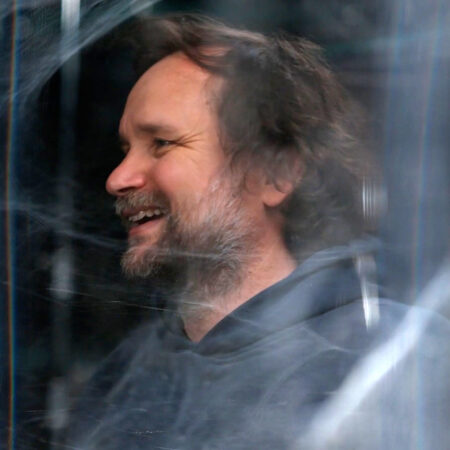
Tomás Saraceno was born in 1973 in Tucuman, Argentina, and currently lives and works in Berlin, Germany. He studied at Universidad Nacional de Buenos Aires from 1992 to 1999 and received postgraduate degrees from Escuela Superior de Bellas Artes de la Nación Ernesto de la Cárcova in 2000 and Hochschule für Bildende Künste–Städelschule in 2003. Uniquely inspired by the structures and behaviors of the “more-than-human” world, Saraceno proposes more just and eco-social ways of experiencing and inhabiting our environment through interactive artworks that bridge architecture, engineering, and sculpture.
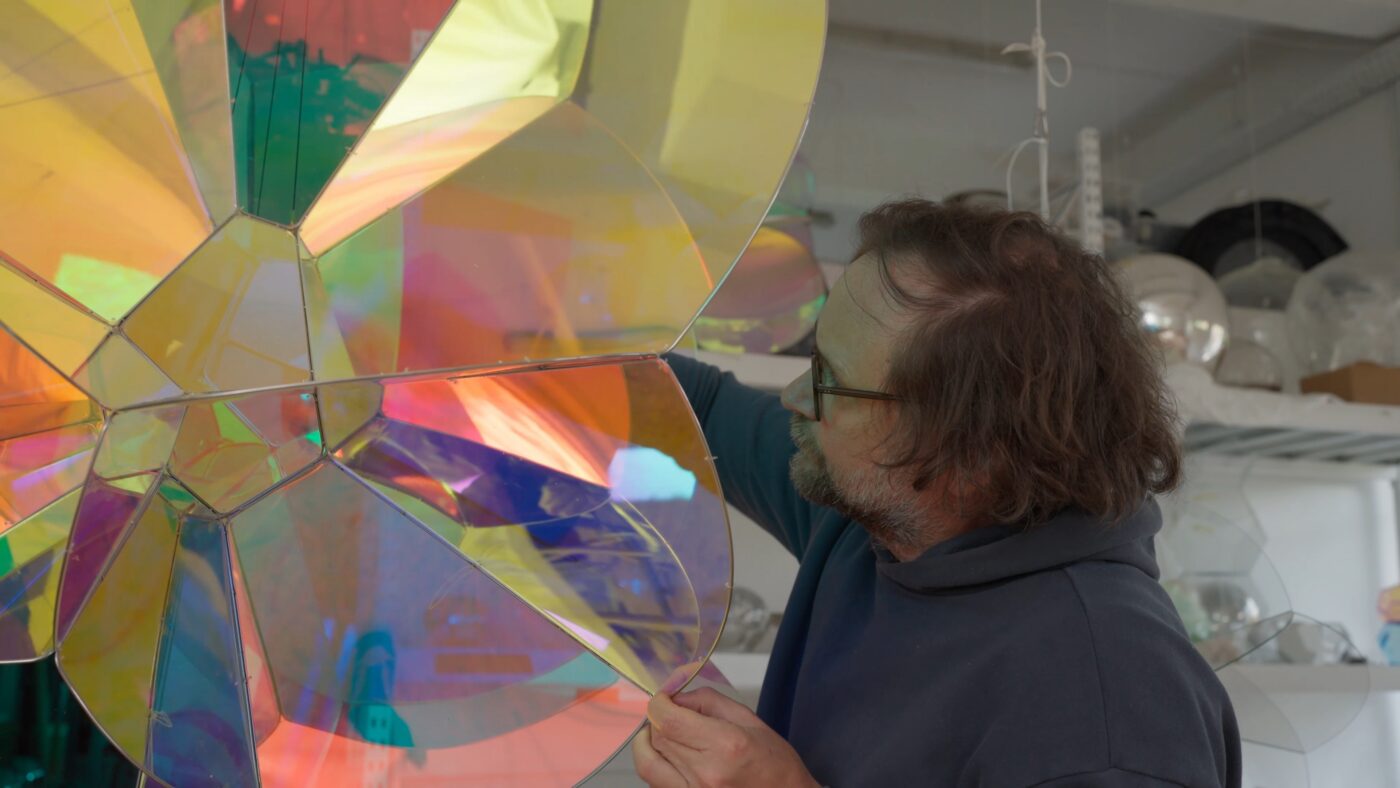
Envisioned as participatory platforms for the communities where they’re sited, Saraceno’s projects are driven by the pressing socioeconomic and environmental issues affecting those communities and the larger world. Developed collaboratively in his Berlin studio, Cloud Cities/Air-Port City (2008-present) is a series of interactive sculptural installations that examine the possibility of an airborne existence and model free-floating international cities independent of borders and free from neo-colonial energy models and the carbon economies of the Capitalocene. Using iridescent panels that reflect and translate the sun’s rays, and modular geometric bubbles, these sculptures propose an adaptable and mobile approach to living. Elsewhere, the artist has developed new modes for reengaging with the environment, such as Museu Aero Solar (2007–present), where he directly collaborates with local communities to collect, recycle, and assemble plastic bags into floating museums powered by the sun. As part of his most ambitious participatory project to date–Aerocene–the artist brought together representatives of the Salinas Grandes’ Indigenous communities, artists, scientists, anthropologists, engineers, and more, to set 32 world records for the most sustainable flight in human history on January 25, 2020. Fly with Aerocene Pacha (2020) rose with the message “Water and Life are Worth More than Lithium,” written with and for the communities of Salinas Grandes and Laguna de Guayatayoc, northern Argentina, who each deal directly with the ecological impact of battery-driven lithium extraction. “The best form of technology should be justice,” Saraceno says. Whether through architectural models or larger-than-life installations, the artist creates works that imagine utopic and just ways of living.
Embracing a collaborative ethos, Saraceno often works with specialists across varied fields, but especially arachnologists, studying and replicating the behaviors of spiders to gain a deeper understanding of our collective existence and to imagine new ways of coexisting. “It’s really trying to extend the ability of understanding who is our family,” the artist says. “By allowing others to admire these incredible webs, [hopefully] they will become more empathic with the work that spiders do.” In Saraceno’s Hybrid Webs (2018), different species of spiders with behaviors ranging from solitary to social, collaborate in a glass box, weaving their webs simultaneously. Through the integrated architectures of their webs, which act as extensions of their sensory systems that allow them to “see” the world around them, these sculptures demonstrate the possibility of unexpected connections across species. In other works, the artist engages the relationship between human beings and webs, whether terrestrial or cosmic. Sounding the Air (2017), Arachnid Orchestra. Jam Sessions (2015), and Free the Air: How to hear the universe in a spider web (2022) explore the use of silk, dust, and spider webs as musical instruments, inviting humans and spiders to interact and converse through sonified movement. In Algo-r(h)i(y)thms (2018), the artist replicates a spider web as a human-scaled interactive installation, inviting viewers to see, hear, touch, and pluck the web’s strings to produce frequencies that range from vibrations that mimic spider courtship to the sounds of electrons in the galactic nebulae. Collectively known as Aranchophilia, the artist’s work in arachnology has achieved several breakthroughs, such as allowing for precise 3D models of complex spiderwebs through the Spider/Web Scan, alongside advancements in biotremology, bioacoustics and biomateriomics, which have been published in journals and produced alongside a wide range of collaborators including spider diviners from Somié, Cameroon and scientists from the Max Planck Institute and MIT.
Videos 2
Trailer
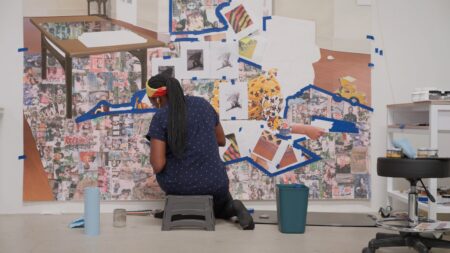
“Spider web is always part of me. It’s really trying to extend the ability of understanding who is our family. By allowing others to admire these incredible webs, [hopefully] they will become more empathic with the work that spiders do.”
Tomás Saraceno