Delcy Morelos
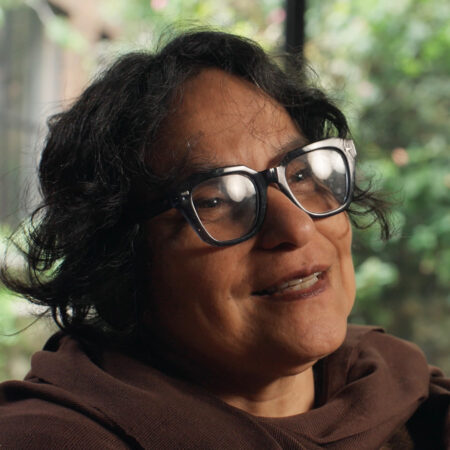
Delcy Morelos was born in 1967 in Tierralta, Colombia, and lives and works in Bogotá, Colombia. She received her BFA from La Escuela de Bellas Artes de Cartagena in 1991. Using materials drawn from the earth, such as pigment minerals, soil, and plant life, Morelos centers our relationship with the natural world, inviting a sense of harmony and dialogue with the environment around us. Across her paintings, sculptures, and multisensory installations, Morelos’s practice weaves together disparate histories and traditions: from Andean and Amazonian Indigenous cosmologies to the histories of violence and extraction in the Americas, using abstract forms and gestures to convey their impact on humanity and the earth.
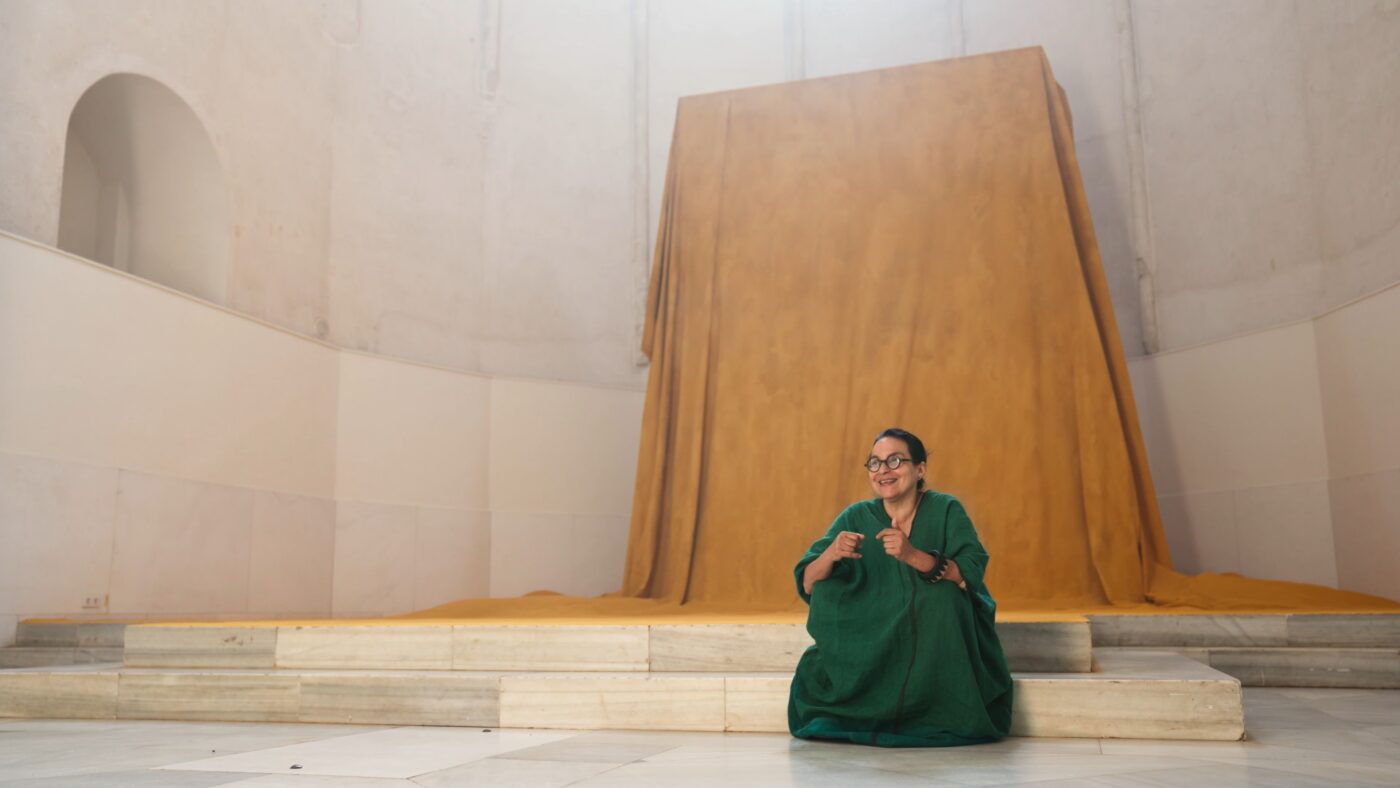
Since 2012, Morelos has worked on large-scale, site-specific, and multisensory works that evoke her deep belief in the spiritual, political, and ecological sanctity of the earth. In works such as El Espacio Vientre (2025) and El Abrazo (2023), the artist draws inspiration from pre-Hispanic and Indigenous sculptures as well as temples and ziggurats to create monumental artworks that envelop viewers and serve as a place for safety and reflection. “When I am working with the earth, when I’m talking with her, I feel complete. I feel I am a part of her,” the artist says. In Profundis (2024), commissioned for the Centro Andaluz de Arte Contemporáneo in Seville, the artist draws on the site’s history as the former resting place of Christopher Columbus. She constructs a draped sculpture with locally sourced albero sand (typically used in bullfighting rings) alongside an installation combining plants Columbus introduced to Europe from the Americas, to highlight how botany, religion, and violence intersected to shape Spain’s colonial history. For works such as Cielo terrenal (2023), commissioned for DIA Chelsea in New York City, Morelos constructs a flat installation in a dimly lit cavernous room, where objects begin to emerge only after the viewer has adjusted to the light. The artist paints the walls to the level of flooding caused by Hurricane Sandy in 2012, a testament to the power of nature. Morelos creates a body of work that depicts the earth as a repository of layered histories, inviting us to connect and repair our relationship with the land.
In her early works, the artist used painting and drawing to explore the history of colonization, racial segregation, and violence in Colombia. Color que soy (1999) is a series of 60 paintings shown together, each depicting a single coffin in different skin tones. Here, the artist recalls the explicit racism she witnessed growing up in Colombia, where persistent social stratification and racial hierarchies impacted the ways people interacted with one another. “My work was my response to the question ‘How can we be so violent with another human being?’” the artist says. “Drawing helps me extract those forms from such infinite possibilities.” In her series En la trama personal (2004), the artist depicts an enlarged plain-weave textile structure in which each thread is marbled with deep reds and browns, drawing a comparison between woven fabrics and organic matter. Morelos reveals the intrinsic similarities between humans, using the overlapping grid to signify our shared internal structures and suggest the potential to overcome racial differences.
Videos 3
Trailer
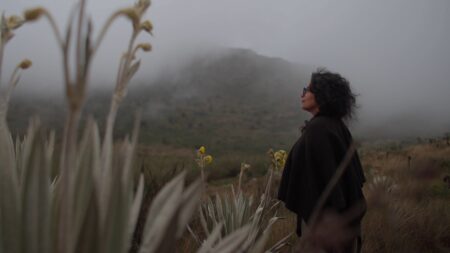
“When I am working with the Earth, when I’m talking with her, I feel complete. I feel I am a part of her.”
Delcy Morelos