
Tishan Hsu
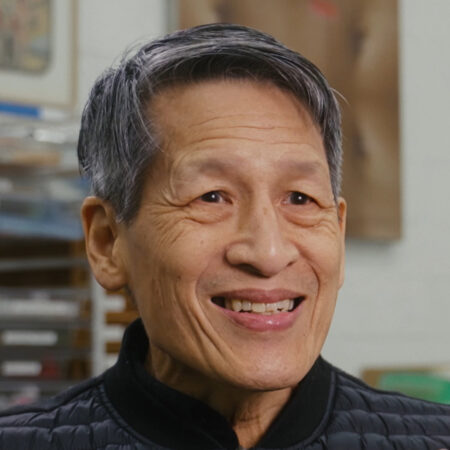
Tishan Hsu was born in 1951 in Boston, Massachusetts, and lives and works in New York, New York. The artist earned a Bachelor of Science in Art and Design from the Massachusetts Institute of Technology (M.I.T) in 1973 and a Master of Architecture from the same institution in 1975. Since the 1980s, Hsu has worked across painting, printmaking, sculpture, video, and more to reflect an evolving relationship between the human body and technology. From early paintings and sculptures that fused emerging digital aesthetics and traditional image-making techniques, to more recent works that draw on the new materials and technologies of the twenty-first century, the artist’s practice examines the transformative interplay between the organic and artificial.
After graduating from M.I.T., Hsu worked as a word processor and recognized the impact that new, screen-based technologies were having on our bodies, minds, and aesthetics. “Technology was going to become part of us in a way that was very different than what people were imagining,” says the artist. “It was going to emerge organically into our lives. Technology was actually getting more human.” From this realization stemmed his decades-long practice exploring the physical and cognitive implications of an increasingly technologically mediated society and culture. In early works, like Cell (1987), Liquid Circuit (1987) and Portrait (1982), the artist engaged a variety of strategies to call attention to the particularities of a new screen-based culture: he rounded the edges of his paintings so they recalled computers and televisions rather than traditional paintings, he hung his paintings so they floated off the wall and reinforced their nature as both objects and images, and he drew together elements of both the natural and digital worlds, like the undulating lines seen in all three works, to reflect their interconnectedness. These works are entirely handmade, using simple tools and screenprinting techniques to create the sensation of an active digital interface, grounding the intangible world of computation in physical space.
Beginning in the 2000s, Hsu’s practice evolved as he incorporated new digital imaging software, silicone casts, and most recently, Artificial Intelligence. These new tools allowed the artist to construct the radical visions of techno-organic fusion that he is known for today, critically reflecting on the impact of emerging technologies. In works from the 2020s, the artist expands his subjects to include the transformation of non-human animals and the natural world resulting from technological advancement. In his sculpture, car-grass-screen 2 (2024), Hsu references commonplace objects like cars but covers them with digitally manipulated and collaged images of grass, bodies, and screens. In Mammal-screen-mauve (2024), the artist digitally warps images of mesh weaving and unidentifiable pink flesh on a stainless steel canvas, disrupting the smooth surface with a silicone protrusion that seamlessly emerges from and returns to the surface. His 2025 video, emergent mesh, alternates between abstracted scenes of grass and flesh interrupted by screens and other objects long associated with Hsu’s practice. Produced in the gaming engine Unreal Engine 5, the work is continuously changing in real time, creating a unique experience for each viewer. After more than 40 years of examining the impacts of emergent technology, Hsu continues to consider and critique the implications of these new tools for humanity’s development. “Our bodies are undergoing transformation in their interaction with technology,” says the artist. “It’s affecting us on a cognitive level, and it’s potentially very dangerous. So the question is, what do we do with this? Where do we want to put boundaries?”
“Our bodies are undergoing transformation in [their] interaction with technology. It’s affecting us on a cognitive level, and it’s potentially very dangerous. So the question is: What do we do with this? Where do we want to put boundaries?”
Tishan Hsu