Sable Elyse Smith
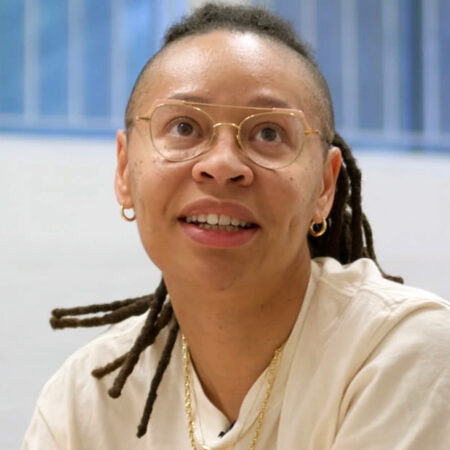
Sable Elyse Smith was born in 1986 in Los Angeles and lives and works in New York City. The artist received her BA from Oglethorpe University in 2011 and her MFA from Parsons, The New School for Design in 2013. Through texts presented in blinding neon, a Ferris wheel sculpture composed of prison furniture, and images ripped from children’s activity books about the carceral system, Smith explores how violence is embedded in built environments, social relations, and linguistic structures. Across her practice, the artist reuses and misuses materials, particularly those drawn from the prison-industrial complex, to create a body of work that questions how specific narratives are constructed, internalized, and repeated.
In 2015, Smith found a coloring book designed to normalize children’s interactions with the criminal justice system through sympathetic prompts, coloring activities, and recurring characters such as “Judge Friendly.” In works such as Coloring Book 9 (2018) and Coloring Book 65 (2020), the artist enlarges pages from the book and scribbles over them to construct new narratives beyond those prescribed. “The throughline was that children would have to do these activities, re-imagining themselves interacting with the judicial system,” says Smith. “I started pulling out these pages to kind of point to that foreclosure of imagination.” In other works, the artist repurposes furniture designed specifically for prisons and prison waiting rooms to underscore the mundane yet inescapable presence of carceral systems in everyday life. Backbend (2019) and A Clockwork (2021) are large sculptures resembling playground structures and Ferris wheels that present the criminal justice system as an unwinnable game. “Sometimes, to empower people to look more closely, something else needs to happen,” the artist says.
In other works, Smith simulates the atmospheric experience of antiblack violence seeping into everyday life. In her Landscape (2017-ongoing) series, the artist presents vignettes and poetic fragments as large neon works, using phrases such as “someone smashed the policeman’s radio And finally silence A black language infinitely And blue in a decade where it finally means sky.” Smith explains, “You have to stop and stare at this thing to read it. In the slowness, the light actually becomes oppressive…reading it literally hurts. It hurts your eyes. And then when you leave, you’re in another kind of daze, and I think that actually is the work.” She uses neon as a metaphor for a kind of violence that is difficult and painful to confront, yet remains a constant, underlying presence. Forcing viewers to sit with the overpowering light and ever present hum, the artist creates a body of work that describes the constant presence of institutional power and the narratives that sustain it.
Videos 1
-
Sable Elyse Smith
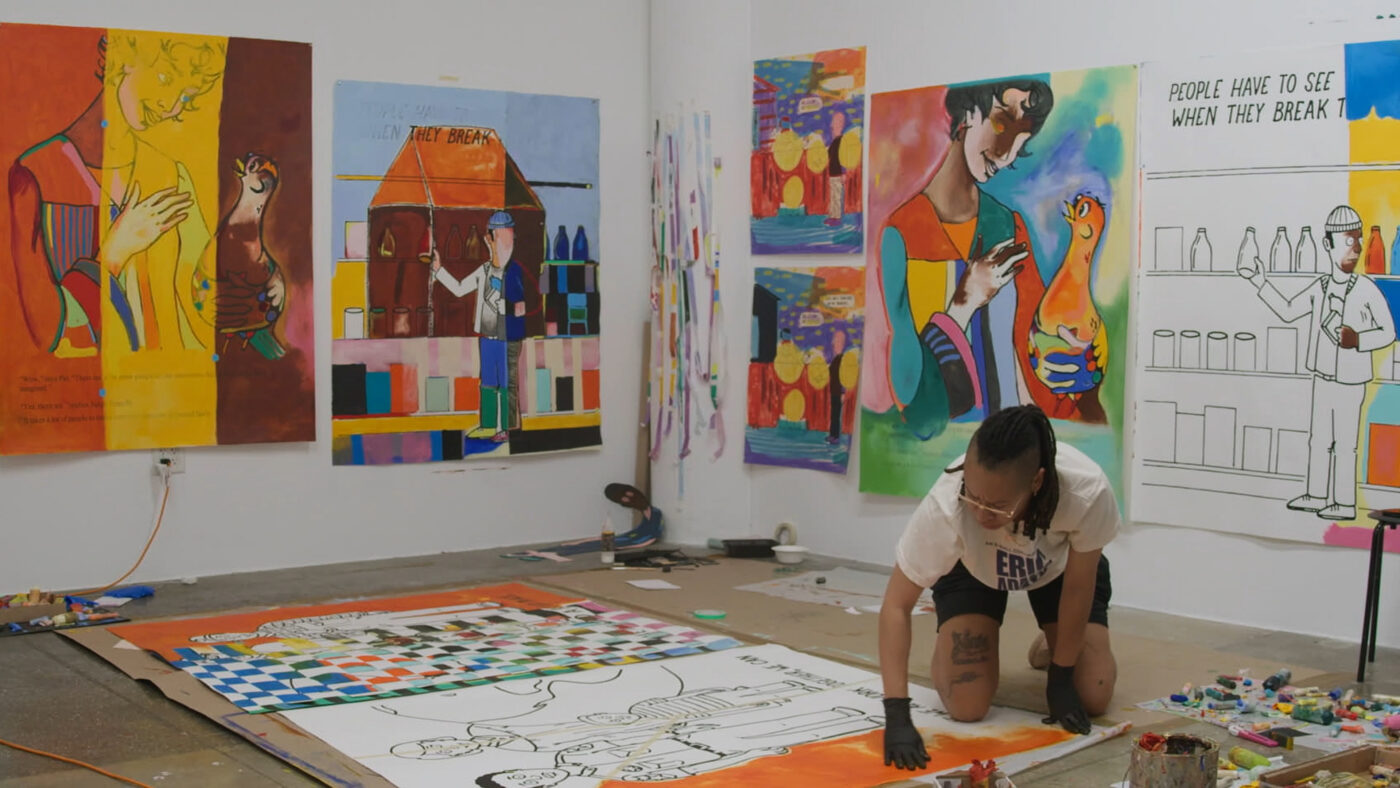
“My impulse is to make and turn things over and use materials and images to process the world and communicate.”
Sable Elyse Smith