Ragini Bhow
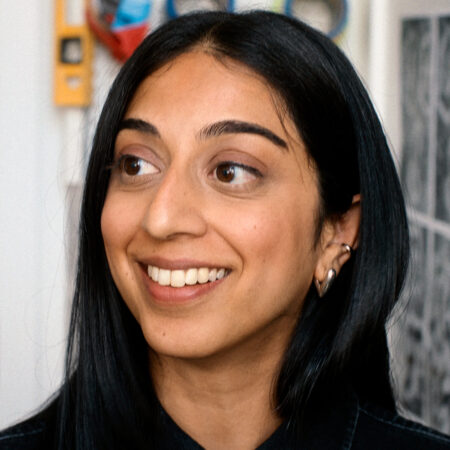
Ragini Bhow was born in 1991 in Minneapolis, Minnesota, grew up in Bangalore, India, and currently lives and works in Brooklyn, New York. She received her BFA from the University of Minnesota in 2013 and her MFA from the University of New Mexico in 2020. Engaging both science and spirituality, the artist draws on natural imagery, scientific forms, and meditation to create work across painting and sculpture. Working intuitively, the artist produces delicately painted abstract works in black and blue, as well as floor sculptures activated in ceremonial fire. Her works move between microbial, cosmic, and supernatural scales, collapsing temporalities and inviting a deeper awareness of the world around us.
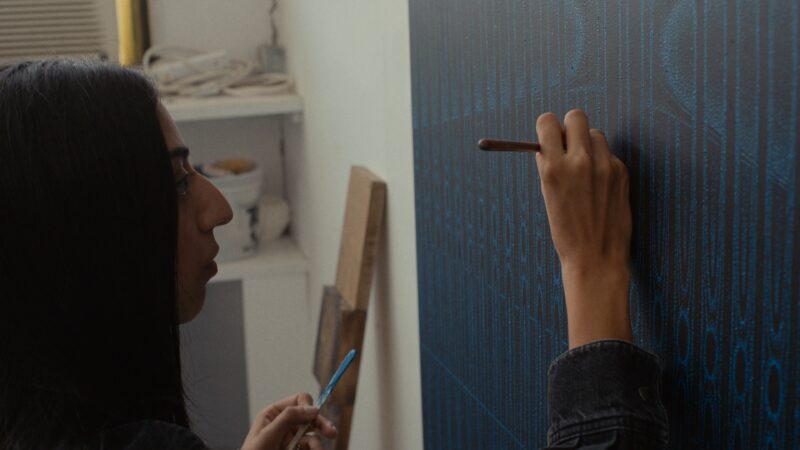
Working with pigments she makes by hand, Bhow uses natural materials such as charcoal dust or black iron oxides for her blacks, and azurite, malachite, and lapis for her blues. Beginning each painting with a layer of black, the artist applies blue pigment point by point, slowly forming the image in response to the canvas and the paint itself. “We often speak of darkness as absence or something to fear. But for me, I see it as something that holds infinite possibility. So much of life begins in the absence of light,” the artist says. In works such as Gateaway (2023), the artist works from a central point, painting a series of dots that cohere into an ethereal, organic-looking structure. In Double Helix (2026) and Cosmogram II (2026), the artist depicts cellular structures that evoke DNA and textbook illustrations of the universe. “Sometimes it takes a really long time for the image to come alive, but over time the density builds and builds and builds”, Bhow says. “It is always a really special moment when the painting reveals itself to me.”
Across painting and sculpture, the artist views her materials as active carriers of energy and memory, each with inherent transformative power. Bhow’s sculptures are often concave, biomorphic vessels that she likens to altars, which she activates through ceremonial burning sessions. The artist then incorporates the burnt ash into other sculptures and handmade pigments, imbuing her painted works with the energy and spirit of fire. “Fire is a force that can release, but it also generates,” Bhow explains. In sculptures such as Vedi I (2024), Tree Walking (2023), and Bones left behind (2023), the artist casts aluminum into elongated spheres, inviting viewers to peer into the soot-covered, cocooned centers of these works, and collapsing the boundaries between creation and destruction. Whether working within sculpture or painting, Bhow creates a body of work that animates the material history around her and underscores our interconnectedness with the world.